
Do You Know Your National Scenic Trails?
There are 11 congressionally designated footpaths stretching north to south and east to west across the United States. See where and how Trust for Public Land is contributing to this impressive collection of American outdoor treasures.
By Deborah Williams | Illustration by Nate Padavick
Updated June 16, 2025



Even nonhikers have heard of the Pacific Crest and Appalachian Trails. They rightly hold elevated status in the modern American zeitgeist. Perhaps slightly lesser known, the Continental Divide Trail is accumulating awareness, especially by section and thru-hikers looking for a path less-travelled. In a third tier of name recognition are the eight other National Scenic Trails. These are no less special, magnificent, or worthy of our attention. This is especially true because they all have stretches that remain at risk of development.
Hover over the numbers on the map to read more about each trail:
A Jewel of America’s Public Lands
“The National Trails System is one of the jewels of America’s system of public lands,” says J.T. Horn, senior director of TPL’s national Trails initiative. “These 11 routes offer the journey of a lifetime to thousands of long-distance hikers, but they also make up close-to-home recreation for millions of people who want to go for a day hike or a weekend backpacking trip. TPL is partnering with the National Park Service, U.S. Forest Service, and trail stewardship groups to accelerate the protection of these routes by helping with mapping and parcel analysis as well as offering land acquisition training for trail managers. We’re also pursuing dozens of acquisitions designed to give these trails a permanent home.”
Established by Congress in 1968, the National Trails System continues to grow as advocates increasingly ring alarm bells about highways, pipelines, vacation homes, and other projects that threaten these special corridors. The trails deliver unparalleled outdoor adventures and facilitate natural wildlife migration. They also help balance sensitive ecosystems and ensure climate resilience for urban and rural communities.
1. Pacific Northwest Trail
Earning its Congressional designation in 2009, the PNT traverses east to west from the Rocky Mountains at Glacier National Park to the Pacific Ocean at the Olympic Peninsula. Trust for Public Land has been protecting land along the route since 1986 and looking for ways to relocate segments of the trail away from heavily trafficked roads. To that end, TPL’s Land and People Lab is developing the first digital mapping tool that will analyze the PNT down to the parcel level.
2. Pacific Crest Trail
The PCT stretches from Mexico to Canada through California, Washington, and Oregon. For two decades, TPL has protected more than 50,000 acres within a half mile of the trail. Expand that buffer to a mile—which in most cases is more inclusive of the footpath’s viewshed, watershed, wildlife corridors, and access points—and TPL’s total protected acreage more than doubles.
For TPL, the strategy and focus for projects along the PCT centers on addressing the trail’s five greatest challenges: climate change, timber harvest, route protection, wildlife habitat, and lack of funding. Even though the trail was designated by Congress, 10 percent of it runs through unprotected land, according to the Pacific Crest Trail Association.
In 2019, TPL completed an extensive conservation effort along the PCT corridor. We partnered with the Pacific Crest Trail Association, U.S. Forest Service, and Michigan–California Timber Company to protect the Trinity Divide parcel, including 10,300 acres along a 17-mile section of the trail. This was the longest unprotected section at the time.
3. Arizona National Scenic Trail
A relative newcomer as a national scenic trail, this AT was designated by Congress in 2009. From the northern border with Utah to the southern border with Mexico, the trail is divided into 43 passages, including sections that pass close to Tucson in the south and Flagstaff in the north. In between, it intersects dozens of rural gateway communities that benefit from the economic activity that trail-based recreation generates.
The Arizona Trail weaves through Saguaro National Park, where TPL helped protect 300 acres along a 1.5-mile stretch of Rincon Creek, the park’s only body of water.
The trail is particularly beloved by mountain bikers. In fact, much of the trail was built to International Mountain Biking Association (IMBA) standards.
4. Continental Divide Trail
The PCT and the AT (Appalachian Trail) may have greater name recognition along with well-earned reputations as journeys of a lifetime, but the CDT is considered by many to be more challenging. The trail stretches from New Mexico to Canada along the spine of the Rocky Mountains. For years, sections of CDT took hikers along roads. TPL has since protected new portions of the trail corridor, allowing for the path to be moved into the wild, making it safer and more scenic. From the Indigenous Zuni and Acoma peoples in what is today New Mexico, to the Blackfeet Nation, whose ancestral lands stretch through today’s Montana and Alberta, Canada, these mountains are sacred. The Blackfeet call the divide “the backbone of the world.”
5. North Country & Ice Age Trails
Considering it’s the longest trail, by far, at 4,600 miles and passes through eight states, it’s surprising the North Country Trail isn’t better known. It stretches from North Dakota to Vermont and skirts three of the Great Lakes while passing through some charming small towns along the mostly rural route. Since 1990, TPL has completed more than 35 projects within a mile of the trail. We’re currently working on five more.
Victoria Lake is a particular gem along the NCT that is also on the Wild and Scenic Ontonagon River on Michigan’s Upper Peninsula. Consequently, the area is popular with hikers, hunters, anglers, and boaters. TPL protected tens of thousands of acres in this corridor, many recently as part of our Forever Northwoods program.
What we know today as Wisconsin was once covered by a huge glacier, and the Ice Age Trail traces the edge of that prehistoric ice sheet. During day hikes or through hikes, you can set foot on ridges, depressions, and other geologic features that are billions of years old.
6. New England Trail
Known to locals as Metacomet-Monadnock-Mettabesset Trail (or 3M), the trail passes through 41 communities and within 10 miles of 2 million people as it wends 235 miles through Massachusetts and Connecticut. Also called the New England Trail, it exemplifies the power of trails to make outdoor experiences accessible.
Like many of its fellow national scenic trails, portions of its route and its viewshed cross private land, making those sections vulnerable to future development that could result in trail fragmentation.
Trust for Public Land has helped protect 2,312 acres within one mile of the NET. That includes 200 acres of scenic cliffs, wetlands, vernal pools, and rare plants on Provin Mountain in Massachusetts and a 1/3 mile of the trail itself that were added to the Silvio O. Conte National Fish and Wildlife Refuge. If not for TPL, this segment of the trail would have been closed, forcing hikers to divert off the ridgeline and detour by walking on a road.
7. Potomac Heritage Trail
Want to take a stroll through early American history while soaking up incredible scenery? You can’t do much better than the 710-mile Potomac National Heritage Scenic Trail, which runs through the heart of the country’s oldest colonies.
Along the route from Pennsylvania through Maryland, Washington, DC, and Virginia, you’ll walk sections of the Great Allegheny Passage, the Chesapeake and Ohio Canal Towpath, and the Civil War Defenses of Washington Trail.
In Northern Virginia, you can visit George Washington’s Mount Vernon Estate. It’s there that TPL partnered with the National Park Service to conserve 2,000 acres at George Washington Birthplace National Monument. This includes 550 acres at the former Popes Creek Plantation.
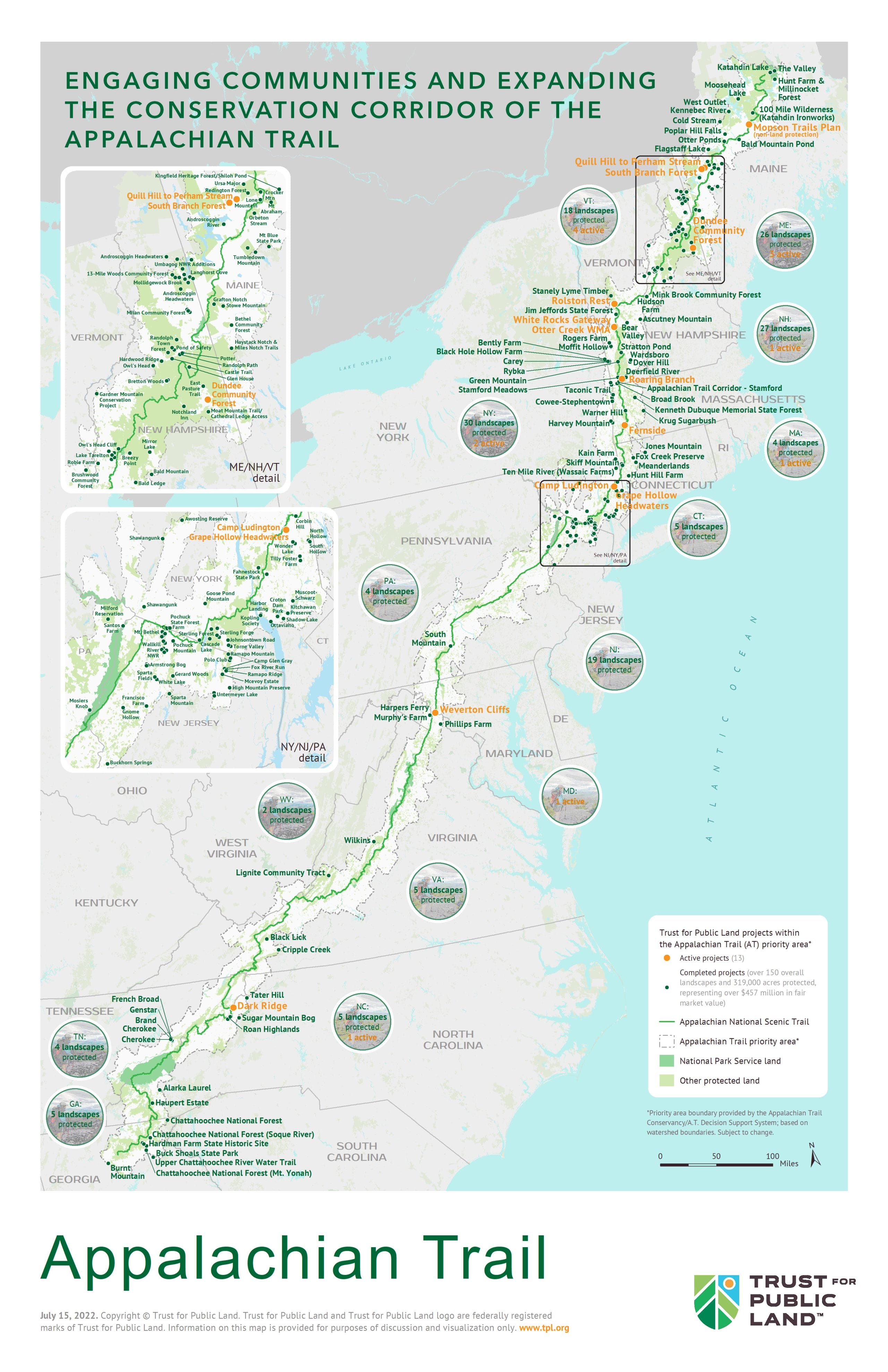
8. Appalachian Trail
Known simply as the AT—by those who’ve visited and those who haven’t—its name-recognition and reputation are well earned. Stretching 2,190 miles from Maine to North Carolina, the route is also one of the oldest scenic trails in the U.S.
Trust for Public Land’s footprint on the AT—pun intended—is significant. We’ve protected 340,000 acres across 160 landscapes in the 14 states through which the trail passes.
Our first project on the AT corridor, which protected land in New Jersey, goes all the way back to 1977. More recently, our protection of 2,600 acres around Maine’s Bald Mountain Pond preserves what J.T. Horn calls “a classic Maine adventure—a paddle-hike combination. It’s not for the faint of heart. It is a wilderness experience, and it’s way out there. But it’s also one of those experiences that really makes your jaw drop.”
9. Florida National Scenic Trail
No matter what type of outdoor experience you desire, you’re likely to find it along the 1,500-mile Florida National Scenic trail. It stretches from the Florida side of the Alabama bootheel to Big Cypress National Preserve toward the state’s southern tip. Within an hour’s drive of most Florida residents, the FNST passes through three national forests, nine wildlife management areas, eight state forests, eight state parks, two NPS-administered properties, and a wildlife refuge.
Located 25 miles northeast of Orlando, the Mills Creek Woodlands was once a 470-acre family-owned farm. When TPL purchased and then conveyed the property to the U.S. Forest Service in 2002, we helped protect a 2-mile section of the Florida Trail.
Deborah Williams is Trust for Public Land’s editorial director. Prior to joining TPL, she spent more than 20 years writing and editing for consumer and trade media in the lifestyle, travel, ski, and outdoor industries.

Donate to become a member, and you’ll receive a subscription to Land&People magazine, our biannual publication featuring exclusive, inspiring stories about our work connecting everyone to the outdoors.