
The Growth of Something Great in the Golden State
Founded in California over 50 years ago, TPL began with a bold perspective on land and people.
By Shantal Riley
Originally published May 15, 2023



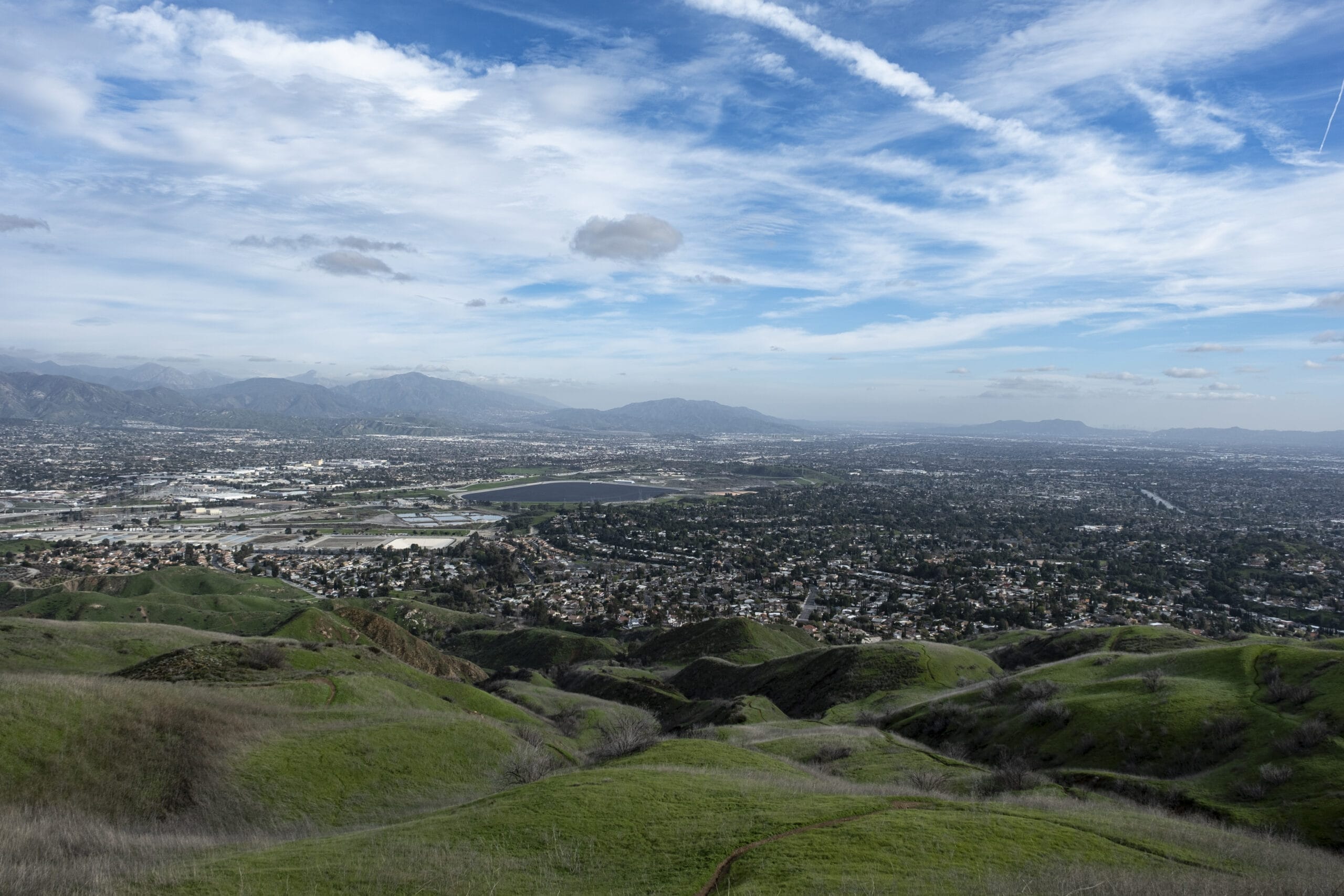
At 2,000 feet, the view from O’Melveny Park stretches from the clay rooftops of Granada Hills to the hazy outline of downtown Los Angeles. On a chilly January morning, muddy mountain streams rage with runoff from recent storms. And the smell of sage and wet earth wafts through the air as hikers ascend the winding Bee Canyon Trail.
The mountainous park encompasses almost 700 acres of rugged trails that traverse rocky ledges, shrubland, grassy meadows, and citrus groves on the eastern end of the Santa Susana Mountains. It’s a haven for local urbanites and home to abundant wildlife.
“I love it out here because you get a very different perspective on the city of Los Angeles,” says hiker Mary Forgione. Indeed, a different perspective—the idea to marry land conservation and public accessibility—led to the preservation of this very ground.
Fifty years ago, part of this majestic park, Bee Canyon, became the first property protected by Trust for Public Land. Like so many awe-inspiring sites around the country, it stands as a testament to the enduring impact of TPL’s work. At the time, Angelenos couldn’t possibly have known the scope of what was to come and the effect it would have on the lives of people across California and the nation.
Of Humble Beginnings
It all started in a small office in San Francisco. It was 1972, and the city was alive with music, art, and social change. A new consciousness had emerged: young people were protesting in the streets—championing civil rights and women’s liberation—and minds were changing about the environment.
The scene was ripe for new ways of thinking and new ways of doing business.
On Second Street, staffers rode a bicycle around the bare floors at a new nonprofit. “I remember sitting on the floor of an empty office,” said Huey Johnson, TPL’s visionary and first president. “One of us would take turns going around and around on a bicycle because there was nothing in the way. We thought it was a wonderful thing.”

“One thing we had back then was a tremendous feeling of excitement,” says Greg Archbald, a TPL cofounder. “We’d come out of the ’60s, out of the Vietnam War . . . we’d seen people walk on the moon. There’s was a feeling of you can do almost anything.”

Huey Johnson, seated second from left, appears both thoughtful and jovial at an early TPL meeting in 1974. Photo: TPL archives
Johnson had been working as regional director of The Nature Conservancy when he met Archbald, one of the first environmental attorneys in California, while biking to catch a ferry. Similarly, he met TPL cofounder Douglas Ferguson, also a lawyer, on a bus headed into the city.
They exchanged ideas about land conservation on their commutes. “There was a real need for a focused, disciplined, professional presence that didn’t exist at the time, to guide complicated land transactions that wouldn’t occur otherwise,” said Johnson, who passed away in 2020. An idea was ignited, and momentum began to build.
The group needed a name; Johnson liked “Project Lorax,” a nod to a nature-loving Dr. Seuss character. “We knew to go fundraising, we probably needed to have something that sounded a little more dignified,” says Archbald, and they eventually settled on The Trust for Public Land.
The business started out with “no money,” said Johnson. Before the year was out, however, they had $700,000 in the bank. Still, it wasn’t always smooth sailing. Just when the financial ball began to roll, there was stinging rejection. Johnson recalled being “full of this vision” when he applied for a loan from the Ford Foundation. They didn’t like the pitch, he said: “They brought in their accountants and they said, ‘This will never work.’”
That didn’t stop Huey Johnson.
Soon, he summoned the nerve to ask Bank of America for a $10 million loan. “Everybody laughed at me, including the board,” Johnson remembered. “They said, ‘You can’t get a $10 million loan without collateral; banks don’t work that way.’”
“Everybody laughed at me . . . They said, ‘You can’t get a $10 million loan without collateral; banks don’t work that way.’”
– Huey Johnson, TPL’s visionary and first president
He came away with a $10 million line of credit. “I got lucky,” he said.
Johnson’s skill as a salesman didn’t hurt, yet he insisted, “It was a blessed operation. Mystical things kept happening.” One day, a call came from an attorney for John O’Melveny, who owned a large ranch on the north side of the San Fernando Valley.
“He got in touch with us and said, ‘We have a proposition to make,’” recalls Archbald. The attorney told him that O’Melveny was doing some estate planning and wanted to protect his ranch from future development—in fact, he wanted a park created on the property.
Archbald went to Los Angeles to work out a deal with O’Melveny’s attorneys and the city council. Ultimately, the 600-plus-acre cattle ranch was turned into a nature preserve. Today, O’Melveny Park, including Bee Canyon, is the second largest city-owned park in Los Angeles.
It was the first project TPL completed, in 1973, and the start of a remarkable journey that would ultimately lead to the conservation of 4 million acres of land—from the salty, windswept California Coast to the busy streets of the South Bronx.

Early Inspiration and Risky Business
A few years earlier, in 1970, the first Earth Day had been held. National parks were being founded. And people were becoming more aware of the need for open space.
Yet, at that time in California’s Marin County, there was little thought given to the environmental impacts of development. “It was taken as a given that development was good, that all development was good, that some development was better than other development and usually that was the bigger development,” says Ferguson.
Marincello was one such project. It was a large-scale development, planned on 2,100 acres in the Marin Headlands. The complex would include a dozen or so high-rise buildings, a mall, and multilane highways to serve 30,000 residents.
According to Ferguson, there was “no consideration given to traffic, no consideration given to water, no consideration given to anything that we today take for granted,” he adds. “There was just progress and progress was good, and progress was right.”
But the project ran into zoning problems and died under the weight of lawsuits, some of which were filed by Ferguson and a young lawyer named Martin Rosen, another cofounder who would become TPL’s third president.
Johnson saw an opportunity and swung into action, securing an option to buy the Marincello property for The Nature Conservancy, which then sold the land to the state. Three years later, the property became part of the newly founded Golden Gate National Recreation Area—to which TPL would soon add its own piece, known as Wilkins Ranch (with more GGNRA projects to follow).
It was a huge win for Johnson, whose reputation was sealed with the venture. The experience also showed him what was possible—inspiring the idea for his transformational nonprofit.
“It’s never been only about birds and bunnies. Risk is inherent in our work.”
– Martin Rosen, TPL cofounder and third president
Despite such auspicious beginnings, by the early ’80s, the outlook for land conservationists became dire. The Reagan administration had ushered in an era of big business, deregulation, tax cuts, and severe reductions in public spending—so deep that senior staff wondered if TPL would survive.
The organization inevitably endured hardship from time to time, and there were people who questioned the legitimacy of TPL’s work. More than once, they had to fight to maintain their tax-exempt status, says Rosen. “It’s never been only about birds and bunnies,” he explains. “Risk is inherent in our work. That’s just the way it is.”
When TPL’s board of directors met at La Fonda Hotel in Santa Fe, New Mexico, in late 1981, they openly questioned the future of the organization and whether they should call it quits. Rosen made the case to persevere: “I felt in my being of being, my soul of souls, that we had the character, we had the talent, we had a window of opportunity, and that we would prevail.”
His instinct was right. In the decades since, TPL has gone on to help raise $93 billion in public funding and build 5,364 green spaces across the country.
The Black Panthers and Equitable Access to the Outdoors
Trust for Public Land did most of its work around the San Francisco Bay Area in those early years. Though the team managed to acquire large swaths of land for nature preserves, they could see that many people were city-bound; in fact, 80 percent of the U.S. population would be living in metropolitan areas by the year 2000, according to the U.S. Census Bureau.
“Going out and getting a Yosemite is great,” says Archbald. (TPL did acquire 400 acres of meadowland at Yosemite National Park in 2016.) “But if you live in the inner city, you don’t have any way to get out there.”
The organization was honing its techniques for land acquisition, but its founders started to ask, “What if we could use those same techniques to get a park that’s closer to the people?” says Archbald.
This was the seed of the organization’s future mission to give people—particularly those who can’t afford to travel far from their homes in underserved areas—better access to the outdoors. That focus led TPL to look across the bay, at Oakland.
The group began to acquire vacant properties through bank donations and payments of back taxes, in what later became the Oakland Land Project. When Steve Costa, a former TPL program director, came aboard, there were over a thousand vacant lots lying idle in Oakland. “These savings and loans institutions had foreclosed these properties and demolished houses and were sitting on close to 150 properties,” he says.
TPL came up with a strategy to convince them to donate the vacant lots. “We weren’t going to accept a property unless we could establish that there was real community interest. That’s when the community organizing really began kicking in,” says Costa. It was the beginning of TPL’s long-standing commitment to advance outdoor equity by combining social justice with conservation.

In the mid-1970s, TPL collaborated with Oakland residents and the Black Panther Party to turn vacant properties into neighborhood gardens, a testament to TPL’s long-standing commitment to partnering with marginalized communities to advance outdoor equity. Photo: TPL archives
Within a few years, TPL had acquired dozens of properties, which were then transformed into miniparks and community gardens—among the first in Oakland. “The land trust movement didn’t exist back in the ’70s,” says Costa. “The fact that here were the first urban land trusts in which inner-city residents were owning, controlling, managing, and improving lots was really pretty remarkable.”
Different groups partnered with TPL on these projects, including churches, charities, and the Black Panther Party—the latter drawing a connection between Black liberation and different forms of oppression. In the words of former Black Panther Party chairperson Elaine Brown: “We said, ‘How can we talk about Black people being free when we’re living in a polluted environment?’ . . . because all of our communities were the most polluted.”
Shortly after joining forces with TPL, the Panthers started its Gardens in the Ghetto project, an urban gardening program in West Oakland that became a model for future urban gardens in the Bay Area. Trust for Public Land’s push to build green, urban space slowly grew into the Urban Land Program, which spread eastward throughout the ’70s, all the way to cities in New York and New Jersey, where vacant lots were emptied of garbage and debris and turned into green spaces. And, in the state of California itself, TPL went on to support the community-led creation of dozens of parks, from Boeddeker Park in San Francisco’s dense Tenderloin neighborhood to a network of public green spaces along 51 miles of the Los Angeles River.
Beyond parks and gardens, TPL’s work also broadened to include the preservation of historic and cultural sites—especially those of underrepresented groups—to help tell a more accurate American story.
Securing land for a visitor center in Nicodemus, Kansas, the oldest remaining Black settlement west of the Mississippi; protecting the once-segregated schoolhouse in Topeka where, in 1951, a third-grader was turned away from an all-white school in the case of Brown v. Board of Education; and donating historic buildings to Martin Luther King, Jr. National Historical Park in Atlanta, Georgia, are just a few shining examples.
Returning Ancestral Homelands
But long before all of this, Indigenous peoples lived in North America as they had for millennia. On the West Coast, these included the Pomo, Yurok, and Nez Perce. Over time, Trust for Public Land collaborated with all three. Today, TPL has worked with more than 70 Tribes and Indigenous groups to protect more than 200,000 acres of ancestral land. The first of these partnerships began north of California, in eastern Oregon.
In 1877, the Nez Perce were driven out of their ancestral home, which stretches across what we now know as Oregon, Idaho, and Washington. More than a century later, TPL was working to acquire a 10,000-acre cattle ranch in the Wallowa Valley, the heart of the Nez Perce homeland. “It was going to the U.S. Fish and Wildlife Service,” says former TPL President and CEO Will Rogers.
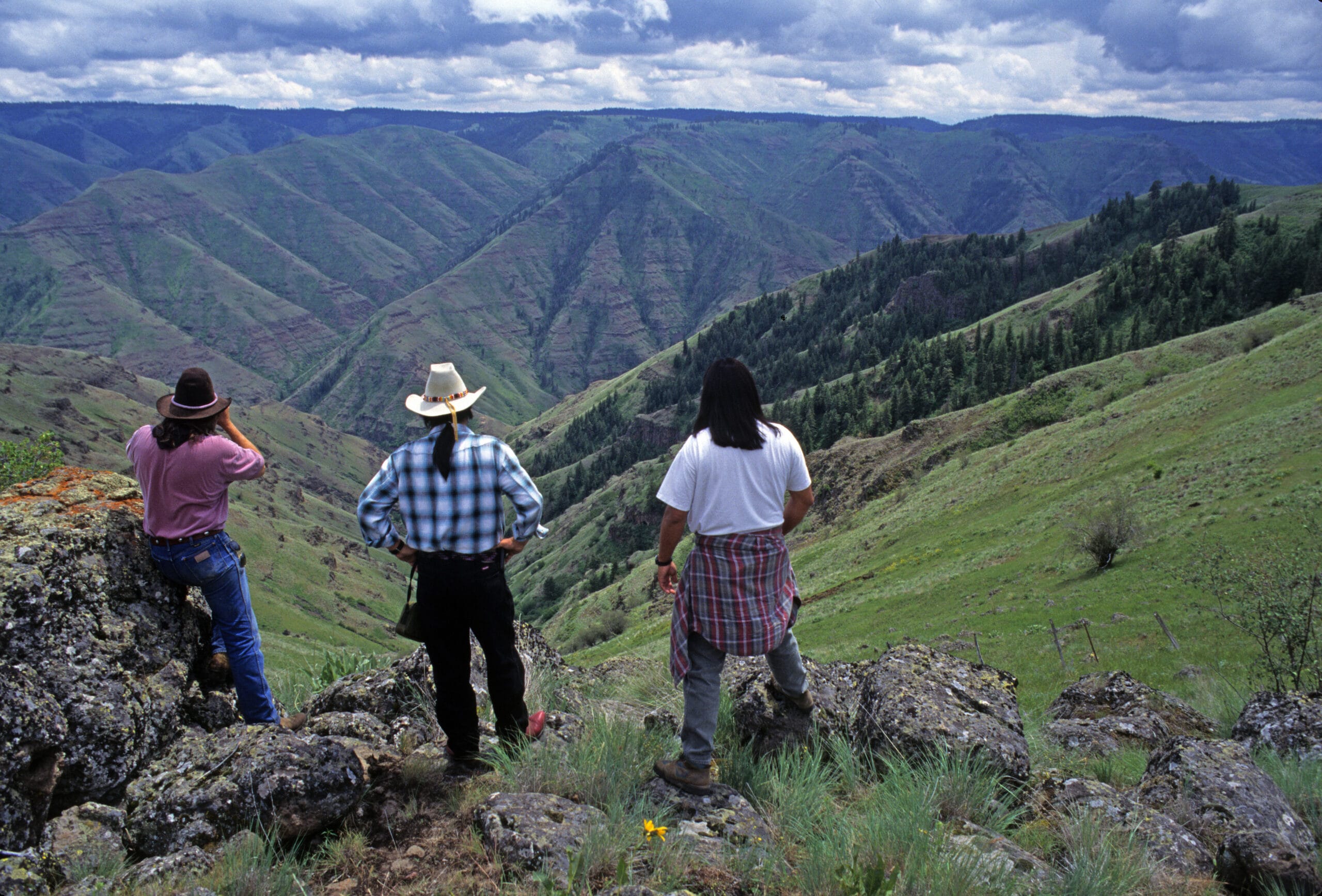
Three Nez Perce men stand on their ancestral land at Chief Joseph Ranch in Oregon’s Wallowa Valley. Photo: Phil Schermeister
Then, one day in the mid-1990s, members of the Nez Perce Tribe walked into a TPL office to talk about the property. The team was dumbstruck. “Our staff in Oregon realized that this land wasn’t going to the U.S. Fish and Wildlife Service anymore,” Rogers says.
“Our staff in Oregon realized that this land wasn’t going to the U.S. Fish and Wildlife Service anymore.”
– Will Rogers, former TPL president and CEO
In 1997, TPL conveyed the property back to the Tribe. The project inspired TPL’s ongoing work with Tribal and Indigenous communities, which includes 2,000 acres returned to the Yurok Tribe in Northern California and 700 acres of towering redwood forest and dramatic shoreline in Sonoma County, home of the Kashia Band of Pomo Indians.
Now the Kashia Coastal Reserve, those 700 acres are permanently protected. “This is not just a piece of land to us,” says Billyrene Pinola, a member of the Kashia, the first people known to have lived in the area. As its stewards, the Tribe manages the property for habitat restoration, sustainable forestry, cultural preservation, and public access along a planned extension of the California Coastal Trail.
“If you don’t know your cultural history, your language, your land, you lose your identity. This property brings us back home,” says Pinola.
As with other projects, TPL’s commitment to Indigenous land protection has reached across the country, from the preservation of Snake Warrior’s Island in Florida and Alakoko Fishpond in Hawai‘i to a new, culturally informed schoolyard at Chiloquin Elementary in southern Oregon.
Land Protection in La La Land
Hundreds of miles south of the Kashia Coastal Reserve, TPL protected an entirely different cultural site: the Hollywood Sign. Shimmering in the sun, its 45-foot letters loom large from atop Cahuenga Peak in Los Angeles. Recognized the world over, the sign is one of the most iconic landmarks of the 20th century.
First erected in 1923, its letters spelled “Hollywoodland”— the name of an upscale real estate development in nearby Beachwood Canyon.
The sign went through many changes over the years; the letters inevitably deteriorated with age and had to be replaced several times, with a major renovation in 1978 that was paid for by a slew of celebrities.
A chunk of land next to the sign had been owned by business tycoon Howard Hughes, who, it was rumored, wanted to build a home there for his onetime paramour, actress and dancer Ginger Rogers. But the relationship ended, Hughes died in 1976, and the 138-acre parcel was sold to a group of investors. The property was eventually zoned for luxury development and put on the market in 2008.

Trust for Public Land saved this special place on Cahuenga Peak, protecting the iconic Hollywood Sign in perpetuity. Photo: Jonathan Alcorn
The sign is legendary, a beloved American symbol, and a nostalgic emblem that harkens back to the golden age of Hollywood. Locally, it’s a source of civic pride and regional identity. In the words of Pascaline Derrick, a onetime TPL project manager in Los Angeles, “The Hollywood Sign is L.A.” When it was suddenly threatened by encroaching development, it sent an electric jolt through the community. The people of Los Angeles took action.
“The Hollywood Sign is L.A.”
– Pascaline Derrick, former TPL project manager
In 2010, Trust for Public Land announced a campaign to raise funds to buy the property, covering the sign with letters that read, “SAVE THE PEAK.” Neighbors raised money at bake sales and concerts. Hollywood moguls including Steven Spielberg and George Lucas contributed generously to the cause. In the end, more than $12 million was raised to purchase the property, which TPL conveyed to the city.
The sign now sits, in all its glory, inside more than 4,000 acres of wild, urban land in Griffith Park, a crown jewel in the sun-kissed Los Angeles landscape.
The Road Ahead
Along the Pacific Coast Highway, west of Malibu, sea-foam skips along the sand, whipped free from waves by strong winds. Pieces of seaweed drape over rocks like lace, and the ocean roars with savage swells.
Deer Creek Beach is a rare gem of undeveloped land in an area dominated by sprawling mansions and private estates. The beach is flanked by the regal Santa Monica Mountains; carpeted with grasses and sage, and dotted by freshwater ponds, they harbor mountain lions, deer, coyotes, and hundreds of species of birds.
But much of the land is still healing from a devastating fire that ripped through the mountain range in 2018, burning almost 90 percent of the Santa Monica Mountains National Recreation Area. The scope of the fire speaks to the fragility of ecosystems found along the coast and other fire-prone environments.

Perched above Highway 1, the bluffs of Deer Creek Canyon provide stunning views and will serve nearly 8 million people who live within an hour’s drive. Photo: Joe Sorrentino
In November of 2022, TPL acquired the massive property, spanning 1,241 acres of coastline and surrounding mountains at Deer Creek Beach. If all goes according to plan—that is, with support from donors and successful collaboration with state and federal partners—over the next two years, the property will transfer to the National Park Service, greatly expanding public access to the mountains and permanently protecting 2.2 miles of pristine shorefront land. The public will be able to hike through it along the planned 70-mile Coastal Slope Trail, connecting Topanga State Park to the south and Point Mugu State Park to the north.
“What Deer Creek Beach represents, not only for coastal conservation, regional biodiversity, but outdoor recreation, and an increase in outdoor equity for Southern California, is immense,” says Guillermo Rodriguez, TPL’s California state director and vice president for the Pacific region.
Rodriguez describes the expansion as a “once-in-a-lifetime conservation opportunity” for TPL and the people of the state. The acquisition also supports federal and state goals to protect a third of America’s lands and coastal waters by 2030.
More immediate is the impact it will have for the 6 million Californians who live within an hour’s drive of the property. In the near future, they’ll be able to reap the health benefits of fresh air and exercise and commune with a breathtaking piece of the Pacific Coast.
Fifty years after Huey Johnson and his partners founded Trust Public Land on a mission to provide everyone with equitable access to nature, the oceanside property is a true example of a green space that not only protects habitats for plants and animals, but for us, as people—regardless of income or social status—to go outside and return to ourselves.
Shantal Riley is an award-winning environmental reporter, who covers pollution in communities of color. Her work has been featured by The Washington Post Magazine, Audubon magazine, and NOVA.

Donate to become a member, and you’ll receive a subscription to Land&People magazine, our biannual publication featuring exclusive, inspiring stories about our work connecting everyone to the outdoors.
