
Composing Landscapes: Hunter Noack's Musical Journey Through Public Lands
Hear from Hunter Noack, classical pianist and founder of IN A LANDSCAPE, about the value of collaboration, the meditative power of nature, and how finding beautiful moments outdoors can deepen our connection to landscapes.
By Sarah Isak-Goode
Published October 14, 2025



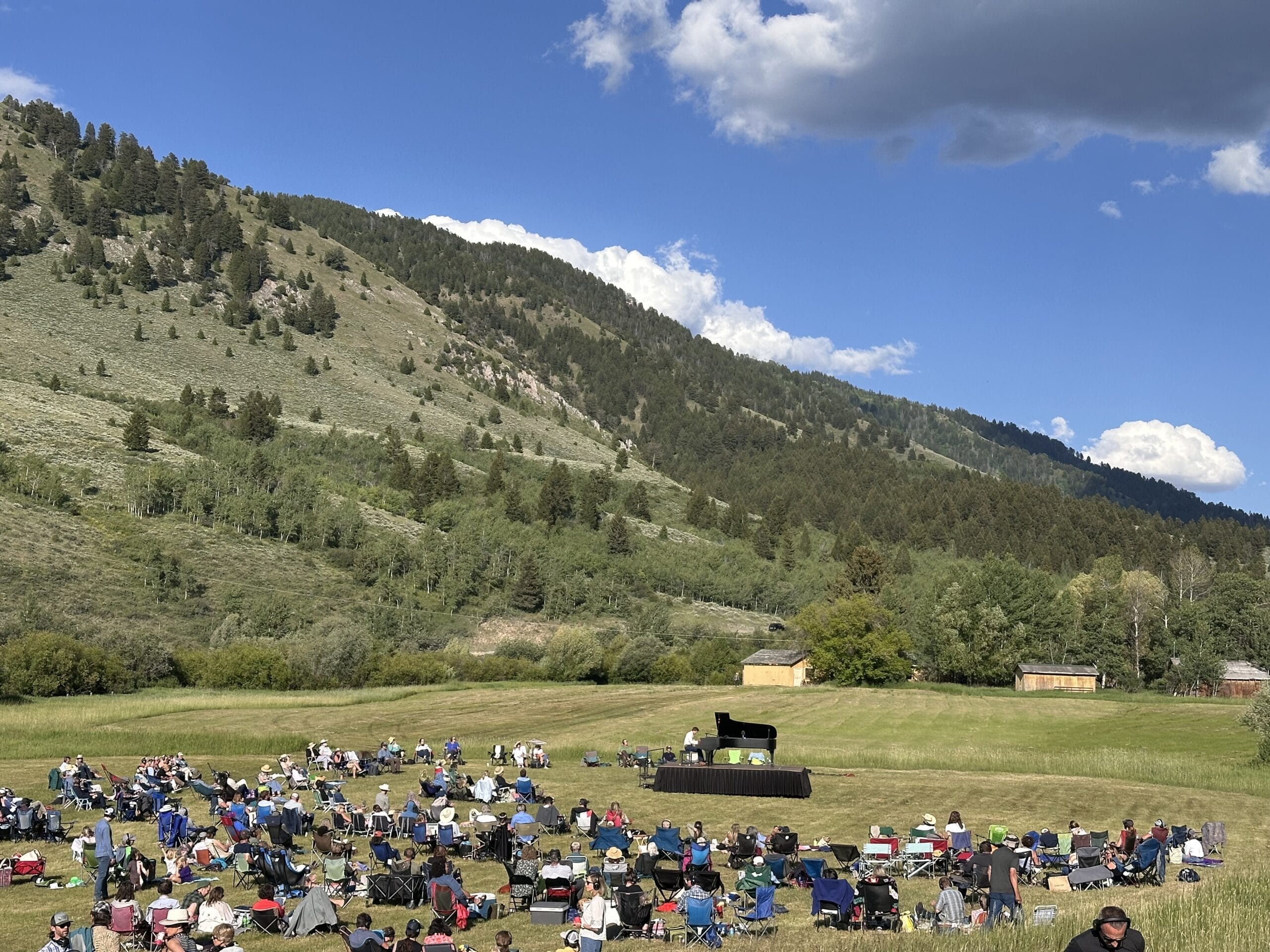
IN A LANDSCAPE: Classical Music in the Wild brings live classical music into the heart of nature—replacing traditional concert halls with wild and working landscapes. With his 9-foot Steinway grand piano in tow, pianist Hunter Noack travels to public lands, parks, ranches, and cultural sites across North America, transforming each landscape into a communal, open-air stage.
Founded by Noack in 2016, the IN A LANDSCAPE series has presented more than 350 concerts, all designed to deepen people’s connection to the land through music. In an effort to make these experiences accessible to all, many performances are offered for free or at low cost, with over $100,000 in tickets given away each year.
For the past three years, Noack has partnered with Trust for Public Land to merge art, land stewardship, and community connection through sound, hosting concerts at TPL sites such as Story Mill Community Park in Bozeman, Montana. In a recent phone interview, we talked with him about the value of collaboration, the meditative power of nature, and how finding beautiful moments outdoors—both in grand compositions and small surprises—can deepen our connection to landscapes.
I love that you advocate for public lands. Tell me a little more about your partnership with Trust for Public Land.
We work together to identify potential concert locations and set up partnerships to highlight the work they’re doing across the West. It’s a collaboration that brings together music and public lands in a way that feels really aligned.
Was there a specific moment or experience that led you to collaborate with Trust for Public Land?
Not specifically, but my interest has always been in land management. IN A LANDSCAPE was initially inspired by the WPA [Works Progress Administration] programs of the 1930s—they presented thousands of free concerts and plays on public lands. I love the idea of public lands as democratic spaces. So, when I started exploring this through music and landscape, it naturally led me to work with groups like Trust for Public Land. They’re a shining example of inclusive, collaborative land stewardship.
Support our work by making a gift today.
Public land use is a layered, complex issue in our country right now. What you’re describing about TPL’s collaboration with local partners really hits home.
Exactly. What’s inspiring about their work is how they bring all stakeholders to the table—not to push a specific agenda, but to build one that works for everyone. Some of the [TPL sites where] we’ve collaborated [to host concerts] are brand-new; others are more established. Either way, the depth of involvement and inclusion is what stands out.
That approach seems to mirror how you connect with the natural world itself. When you’re outside now, do you feel like you listen to the environment around you almost like it’s a symphony?
Yeah. John Muir said, “Going out, I found, was really going in.” When I’m outside hiking, sitting, or hunting, what matters is noticing the magic around me. Inside, everything’s static. Outside, it’s all constantly changing. Your senses become sharper. And that kind of noticing—of sound, smell, light—is a kind of meditation. Music helps people who aren’t used to that kind of stillness get there. It becomes a kind of entry point, like a guided meditation.
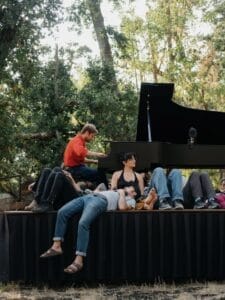
Noack encourages concertgoers to lay under his piano and feel the vibrations of the music as he plays. Photo: Sarah Isak-Goode
Your music is that “way in.” It sounds like IN A LANDSCAPE really started from your love of both music and being outdoors?
Exactly. It began with those two loves. But what’s kept it going is seeing how deeply it impacts people. There’s something about being in a beautiful place with a soundtrack that transforms the experience. And it’s not just about the music or the view—it’s also about learning from the people who steward the land, whether it’s a timber manager, a rancher or a Tribal nation. That deepens the connection for everyone.
To create that kind of connection, it’s as if you’re not just a music composer, but a composer of layered, multimedia experiences that bring land, people, and sound together.
That’s a beautiful way to say it. In many working landscapes, people are essential to the story. The land is open space because someone’s actively managing it. I’ve seen a big shift—even in just the last decade—toward more collaboration between conservationists and ranchers, land trusts and working landscapes. We don’t get far in black-and-white thinking. True progress comes when people work together to create something new—something no one had imagined before.
That’s where the hope is, right? In the conversation.
Yes. When we listen and try to solve a problem together, we don’t just compromise—we innovate. That’s where the magic happens.
I love that—listening as a pathway to innovation. It makes me think about how you first learned to listen. You grew up in Sunriver, Oregon, surrounded by nature. Do you have a particular childhood memory where you felt your connection to nature and creativity taking root?
I think when I was younger, I just spent so much time outside that I didn’t know any other way. I didn’t think of it as special until I left it. As I grew older, I started noticing how people who live or work in nature carry that with them—in their voices, their stories, their whole worldview. That’s what drew me in. Whether it’s a lifelong cowboy or a writer who’s lived close to the land, there’s something deeply beautiful in the way they see the world.
That beauty really comes through in your work. You’ve mentioned that your partner, Thomas, has a particular love for vintage things. It sounds like a similar perspective: There’s a certain romanticism, an appreciation of craftsmanship and beauty.
Exactly. It’s not just nostalgia—it’s about intention. It’s about people who make the world more beautiful, whether that’s through storytelling, working the land, or playing a melody. That’s what I find most romantic: people who are creating beauty in whatever way speaks to them.
Yes! And the beauty can be subtle. Like here in central Oregon, we don’t get much smell in the air—until it rains. Then suddenly, the sage and the soil are fragrant.
Totally. That’s one of those little sensory miracles. It hits you in a deep place. What surprises me at every show are the moments that we could never plan: when the waves seem to flow to the pulse of the music or a flock of geese flies over at just the right time. The synchronicity feels like magic.
Learn more at inalandscape.org. Keep an eye on events.tpl.org for upcoming concerts presented in partnership with TPL.
Sarah Isak-Goode is a reporter for The Source in Bend, Oregon, and has written for The Collector and The Confluence, among other outlets. She is passionate about representing the human experience, no matter the subject. When not writing, she enjoys painting, reading historical texts, and hiking with her dog, Thor.

Donate to become a member, and you’ll receive a subscription to Land&People magazine, our biannual publication featuring exclusive, inspiring stories about our work connecting everyone to the outdoors.
