

Going Where the Wild Things Are
In California and Washington, TPL is cultivating a new generation of campers and nature enthusiasts by getting young people into the wild—many of them for the first time.
Story and photos by Jorge Rivas
Published July 20, 2025



A deep sense of nostalgia takes hold when you arrive at Camp Waskowitz. Nestled in the picturesque foothills of Washington’s North Cascades, it recalls the sleepaway camps of coming-of-age movies and young adult novels. The region is often referred to as the American Alps because of the stunning scenery.
That dramatic mountainscape surrounds the original cabins, built in 1935 and remarkably well preserved. The flowing water of the South Fork Snoqualmie River serenades trees draped with neon green moss. Rustic wooden signs with bright hand-painted lettering welcome you and provide directions across the camp. It’s nothing short of idyllic.
In 2024, Trust for Public Land conserved 345 forested acres at the camp, ensuring this treasured place remains accessible for generations of students and campers to discover nature and hone vital life skills. “The surrounding forest is integral to the feeling of a wilderness adventure,” says Laurie Benson, TPL’s Washington State conservation director, who was deeply involved in the effort to protect the landscape.
“It’s a once-in-a-lifetime experience for fifth graders who camp here,” says 17-year-old high school senior and camp leader Star Whiteley, who first visited the camp two years ago. “I just feel so comfortable being here.”
As a peer educator and camp leader at Waskowitz, Whiteley helps younger students feel comfortable here too. She’s made the hour-long journey from her home in Sea-Tac to Camp Waskowitz—now called Waskowitz Outdoor Education Center— almost a dozen times as a high school leader.
“My role is to encourage and uplift students on their education journey here,” says Whiteley. She leads groups on hikes, science lessons, and games. She’s also there to be a supportive peer, answering questions and calming fears to ensure everyone has a joyful time.

Throughout the four-day camp excursions—which take place during the regular school year in fall or spring—students explore outside, rain or shine. And no one is left out: Every fifth grader in the Highline School District south of Seattle is invited to the camp and outdoor school as part of the regular academic curriculum. In fact, Washington State covers the cost for any student who wants to attend through an organization called Outdoor Schools Washington.
That means introducing a lot of kids to hiking and camping for the first time. Highline has an extraordinarily diverse student body. There are notable populations who speak Spanish, Somali, Arabic, and Vietnamese—a total of 89 languages are spoken at home. Many of the students come from working-class families, and after-school trips to parks are rare.
But regardless of background or familiarity with nature, the students find their connections to the wilderness and each other during their time at camp. Whiteley, who describes herself as awkward and suffers from allergies, says she hated the outdoors before she was introduced to Camp Waskowitz. Then she discovered the calm of being immersed in the forest. “It’s so peaceful here; I will keep coming back here as much as I can.”
While high schoolers like her lead some activities, classroom teachers also morph into wilderness guides for the week, giving students the chance to see them in a different light. While learning about insects, wildlife, and the ecology of the woods, campers connect with their peers and teachers in a new way and develop leadership and communication skills. “It’s just a perfect way to dive into the deep end of making friends and building community,” Whiteley affirms.
Making Connections
Fifth graders visiting Waskowitz learn and live together in a way that’s more impactful than just going to school during the day. The outdoor education element provides these young students with opportunities for social-emotional learning along with science understanding.
When Yusuf, 10, struggled to hike up a steep hill because he’s afraid of heights, tears flowed down his face. “I was so high up, and then I got super scared,” Yusuf says. This was his first hike and his first time camping.
His classmates, however, didn’t make fun of him. They supported him with patience and encouraging words. The students understood that they couldn’t leave anyone behind, and to get up the hill, they needed to operate as a unit.
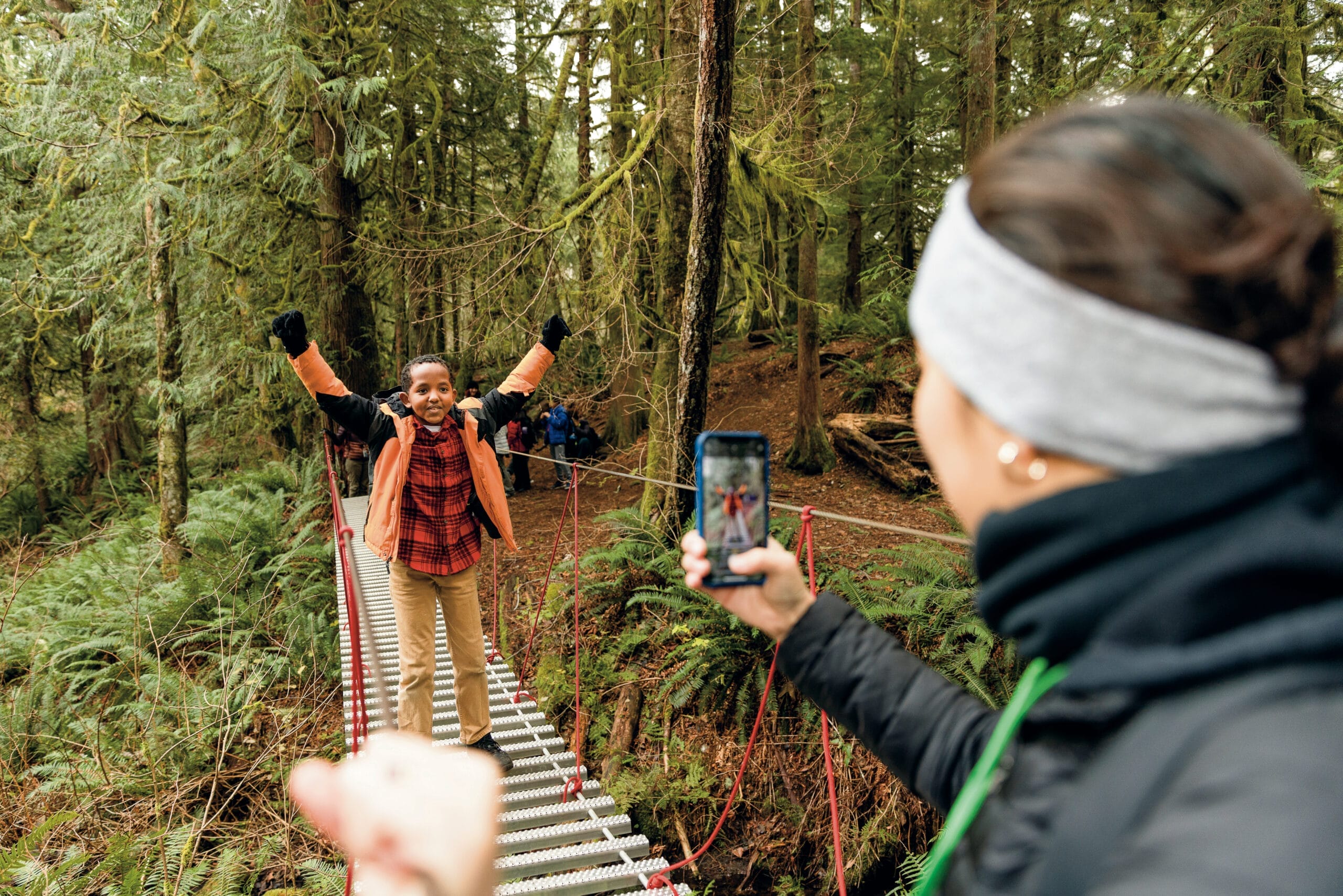
Yusuf, a fifth grader attending Camp Waskowitz Outdoor Education Center, felt triumphant upon crossing a suspension bridge. Photo: Jorge Rivas
“When I grow up, I’m going to hike more. I love hiking and cabins now,” Yusuf shares.
The students reassured each other again as they crossed a 50-foot-long tension bridge that wobbled back and forth with each step. It’s a highlight for most of the campers, but the shaky walk traversing a stream can be equally nerve-racking and exhilarating.
“When I grow up, I’m going to hike more.”
– Yusuf, a fifth-grade student at Waskowitz Outdoor Education Center
One by one, students crossed the bridge, gripping both handrails for dear life. With each student who successfully traveled over, the cheer squad on the other side grew. “They were screaming until they were red in the face,” attests Dasol Lim, Yusuf’s teacher.
These moments build lasting bonds among students—and that closeness extends to their educators too. “I like my teacher more now,” says Yusuf, who also shares that seeing his instructor outside the classroom was fun.
“I’ve noticed that I’m joking around and laughing with them a lot,” adds Lim. She says quiet students become more comfortable making connections outdoors. “I feel like they’re able to thrive when they’re outside, and there are no walls keeping them constrained,” explains Lim, who’s brought her students to the camp for the past three years.
She describes one of the loudest cheerleaders on the tension bridge as a student whose “personality often feels too big for the classroom.” At camp, that student was able to channel his energy to boost the confidence of his classmates. His enthusiasm was so infectious that even students who aren’t as outspoken joined in and boisterously rooted on their classmates.
Lim adds that in a technology-driven world where kids are on their screens all the time, it can be harder to create spaces for students to cultivate community. “Being outside and removing technology allows students to make connections as human beings out in nature rather than through a screen,” she explains.
Those human connections, says Lim, give students a sense of belonging that makes them more excited to attend school afterward.
A Lasting Impact
Students also walk away with a sense of responsibility toward nature, an understanding that “human interactions are impacting the natural world just like nature is impacting humans,” says Meredith von Trapp, director of Waskowitz Outdoor Education Center.
It starts with leave-no-trace lessons at lunchtime. If a napkin or food wrapper falls, you hear the students calling on their classmates to pick up after themselves.
In their end-of-camp surveys, students write things like, “I care so much about the environment now,” and “I’m excited to care for the land,” according to von Trapp.
“If we all had more opportunities to be outside and to feel that calm, grounding connection to the land while connecting to each other, I just think the world would be a better place,” she reflects.
The interpersonal connections both Lim and Von Trapp mention are especially significant given the increasing feelings of loneliness reported by young people. There is a strong body of evidence that supports time in nature as essential to our mental, emotional, and physical well-being—especially during childhood development.
And the growth students experience isn’t fleeting—it goes well beyond post-camp surveys. The lessons and memories stay with the former campers decades later.
“If we all had more opportunities to be outside and to feel that calm, grounding connection to the land while connecting to each other, I just think the world would be a better place.”
– Meredith von Trapp, director of Waskowitz Outdoor Education Center
A 10,000-member Facebook group of Camp Waskowitz alumni is filled with comments about visits as early as the 1950s. “I still remember Mr. Harry Lemon teaching us about the age of trees, in 1961,” wrote one alum on the page. Another member posted a picture of his license plate frame that reads, “I’d rather be at Camp Waskowitz.” And someone who was at the camp in 1972 wrote, “I absolutely loved it so much, I cried all the way home on the bus. This place was magical.”
Perhaps even more telling is that Camp Waskowitz alumni have gone on to become leaders in their communities. Alumni include former U.S. Secretary of the Interior Sally Jewell, former Washington Congressman and Governor Jay Inslee, and Washington State Superintendent of Public Instruction Chris Reykdal.
It Takes a Village—and Serves One Too
One of only a few overnight camps in the nation owned and operated by a public school district, Waskowitz is a rare site through and through: a place where outdoor education, environmental conservation, and historic preservation meet. It’s also a testament to the power of collaboration.
The camp was constructed by the Civilian Conservation Corps (CCC), a Depression-era government work program that made a huge impact on parks nationwide. Waskowitz was used as a base for U.S. Forest Service projects in the Snoqualmie Valley area until 1942.

Highline Public Schools students explore the forest at Waskowitz Outdoor Education Center in North Bend, Washington. Photo: Jorge Rivas
Highline Public Schools, in south King County, began sending students to Camp Waskowitz in 1947 and purchased the camp 10 years later. In 1993, it was added to the National Register of Historic Places. Every year, about 3,000 fifth-grade students attend its outdoor school.
But as in many beautiful places, development has inched closer to the site in recent years. This is where Trust for Public Land came in. Highline Public Schools tapped the organization to help protect the camp, and TPL successfully negotiated a $7.3 million conservation easement to save the land from development in perpetuity.
“It’s such an important experience for these kids,” says TPL’s Benson, “especially considering that the learning takes place in this magnificent forest. It’s an opportunity that a lot of these students just wouldn’t have otherwise, and for many, it can be life changing.”
In a collaborative effort that included the Mountains to Sound Greenway Trust and funding from King County, the arrangement means that the school district will continue running its outdoor education programs, and when school programs are not in session, the 300-plus acres of forest and trails will be open to the public. This newly established access is a direct result of the deal brokered by TPL. “It’s a win-win for outdoor education and public access,” says Benson.
“Not only is the land around the camp protected, but the funds generated from the conservation easement are going straight back to endow the camp,” she adds. “They’ll be used to help preserve the outdoor education facility and maintain the historic CCC buildings.”
Benson says the partnership aimed to “take as much of the burden off the school district as we possibly could.” She credits much of the effort’s success to the Jim Ellis Fund for Land Conservation, which was started by TPL and the Mountains to Sound Greenway Trust to invest in complicated, expensive, but high-impact projects in the area.
“Conservation is a team sport,” says Jon Hoekstra, executive director at the Mountains to Sound Greenway Trust. “We were all able to combine our strengths and capabilities to develop a project that’s really special and is going to make a huge difference for generations to come.”
In this way, TPL’s work goes far beyond land protection: It influences life interests and, potentially, career paths. Whiteley says she didn’t know what she was going to do after high school, but hiking with younger students at Waskowitz helped her find direction.
“I was just so happy being able to talk with fifth graders and [having] them look up to me that I told myself, ‘This has to be my lifetime goal, to be a teacher,’” she announces with a huge smile.

A Family Affair
A thousand miles south of Camp Waskowitz and just minutes from downtown Los Angeles sits the Jose A. Castellanos Campus—an elementary school that’s home to TPL’s first community schoolyard in the city. It’s part of a larger effort (named 28×28) to transform 28 asphalt playgrounds into high-quality green spaces by 2028.
The Pico Union district, where the school is located, has a long legacy of welcoming immigrant communities. In the 1930s and ’40s, it became a hub for many Europeans, including Greeks, Norwegians, Swedes, and Russians. By the 1980s, Central Americans fleeing civil wars also made the area home. Today, you can get falafel at Papa Cristo’s Greek Grill and a Salvadoran pupusa on the same block. But parks in the neighborhood are few and far between. Before TPL made the community schoolyard a reality for Castellanos students, the closest greenery was Angelus Rosedale Cemetery across the street from the school.
Trust for Public Land partnered with the school’s administration, students, and neighbors to reimagine how the previous, traditional schoolyard could become a vibrant outdoor learning space. TPL Community Organizer Dayana Molina and TPL Project Manager Matilda Reyes collaborated with designers and planners to create a space where students and neighbors could actively share their vision for the project.
Many of their wishes came true, including a soccer field and new playground equipment. Other changes nod directly to nature: Instead of metal benches, there are large logs for sitting. Bright green grass, wood chips, and granite pebbles replaced asphalt and bare ground. And more than two dozen native trees were planted, which will provide vital shade and cooling from the increasing heat.
Several students who helped design the schoolyard have remained connected to TPL and attended an after-school program run by Molina. Through a unique partnership between Trust for Public Land and local nonprofit Outward Bound Adventures (OBA), those students—and their parents—got even more immersed in nature on a one-night camping trip last fall.
The families traveled to Wind Wolves Preserve two hours north of the city, a popular outdoor destination where, in partnership with the California Rangeland Trust, TPL permanently protected 14,631 acres in 2021—and added another 13,515 acres in February of this year. It’s a majestic place with peaks and valleys as far as the eye can see.

OBA instructor Maggie McSparran demonstrates tent assembly at Wind Wolves Reserve. Photo: Jorge Rivas
“The schoolyard was completed last year, so this program is a way for us to continue relationships with those families and continue to connect them with nature—both near home and now a bit farther from home,” says Molina, who accompanies campers on most OBA trips. Each round of the program serves 20 families at time, with introductory day trips followed by overnight camping.
There have been a handful of TPL–OBA excursions so far. But over the course of the next three years, the organizations will take hundreds of people camping in nearby natural areas including the Santa Monica Mountains and Angeles National Forest, which borders a number of TPL-protected landscapes that, stitched together, make a large expanse of wilderness.
Into the Wild
On a crisp Saturday morning in October, families gathered with their duffel bags and suitcases at 8:00 a.m. in front of the Castellanos school. One even came with a grandmother—three generations being introduced to camping in one fell swoop. The youngest camper was just 3 years old.
Pasadena-based Outward Bound Adventures (not to be confused with the similarly named international nonprofit organization) provided transportation, food, tents, sleeping bags, and sleeping pads.
These resources open camping up to families that might not otherwise be able to try it. The federal government classifies Castellanos as a “high poverty” school.
Funding comes from the state’s Outdoor Equity Grants Program (which was created through AB 209 and administered by California State Parks’ Office of Grants and Local Services); TPL and OBA applied for the grant together. Molina says it was an intuitive partnership since OBA specializes in “customized activities that engage families to get out and learn about the environment,” with a focus on underrepresented communities.

TPL’s Dayana Molina and a camper take a closer look at the local plant life. Photo: Jorge Rivas
Diverse camp leaders and culturally relevant programming also add comfort to the outing: “It truly elevates the experience that kids and adults see themselves in the instructors and can connect with them,” says Molina.
“It truly elevates the experience that kids and adults see themselves in the instructors and can connect with them.”
– Dayana Molina, TPL community organizer
During the two-hour journey to the campground, Castellanos families learned about everything from how to read paper maps to the Indigenous history of the region. Nathan Nuñez, an OBA field instructor, told families about the different Native American tribes with historic and current ties to the area, adding context to the landscape and imbuing it with richness.
Nuñez says that when young people understand how they’re connected to the elements in the environment, from rocks to plants, “it really helps us take that connection to the next level of building the next generation of stewards.”
The scenery doesn’t hurt either: During spring months, the fields burst with bright yellow and purple wildflowers, attracting travelers from afar. In the fall, the hills glow in golden hues at sunset. In any season, nature puts on its best show.
“Camping was scary at first because I felt a bit clueless,” confesses a mom named Karla, who brought her 7-year-old son, Anthony, and 3-year-old daughter, Aniyah. Despite being the adult in her party, it was also Karla’s first camping trip.
But OBA staff are on hand and ready to show families how to set up their campsites, and the families leaned on each other and worked as a team. It eased some of the insecurity Karla mentions, knowing they were all in this new experience together.
From making barbacoa for dinner to roasting s’mores for dessert, campers began to loosen up. Kids played soccer in a clearing, and señoras sat chatting under shade trees until sunset. An uncle napped in a tent during some down time. As Molina puts it, “The families made this trip their own.”
A Sense of Stewardship
Karla came to the United States when she was 6. Her mother had a close relationship with nature in Mexico, which she fostered in her children. Karla grew up visiting parks in L.A., but she says going away camping was more daunting—and requires more resources.

Campers Anthony (left) and Aniyah at Wind Wolves Preserve, where TPL protected 28,000 acres of land. Photo: Jorge Rivas
She suspects the families in her neighborhood don’t go camping because of cost and lack of information—including multilingual resources; roughly half of the students at Castellanos are classified as English-language learners. But she’s hoping to inspire an interest in the outdoors in her children by taking part in programs like this. And it seems to be working.
“I had a bad dream,” 3-year-old Aniyah reports, “but I love camping.” Even being scared of some off-putting insects didn’t deter her overall positive takeaway. In fact, the rustling leaves and howls of coyotes at night created more excitement than fear—and gave campers moments to remember.
Time is another barrier to camping for Pico Union families. “Sometimes you just can’t make the time to go outdoors because work is the priority,” explains Bertha, the grandmother in the group, who joined her daughter, son-in-law, and grandson.
Bertha grew up in an adobe house in the mountains of Oaxaca, Mexico, where there was a natural sense of stewardship to the earth. She recounts long outdoor walks to school and a home that only burros could reach, with cars nowhere in sight. And she visited a nearby river regularly.
Then she moved to the U.S., where she says she’s had to “work, work, work.” While Bertha is grateful for an income that allowed her to put her children through college, the disconnection she feels from nature as an urban resident is acute. For her, this was a one-of-a-kind trip she’ll never forget.
“Nature is the best thing there is,” she says, adding that she encourages her sons and daughters to take their children outdoors, even if they’re tired or short on time. In fact, she persuaded her daughter to attend the Castellanos camping trip by reminding her that such opportunities are fleeting: “Those moments don’t come back,” Bertha attests.
“Nature is the best thing there is.”
– Bertha, a camper on the TPL–OBA trip

Bertha (left) came camping with her grandson Danny and encourages her family to make the most of their time together outdoors. Photo: Jorge Rivas
When a leaf falls from a tree, she picks it up and stops her grandson. He understands what to do. He closes his eyes, and Bertha places the leaf on his face and says a prayer.
“I pray that I’ll be able to repeat this experience one day,” Bertha says, expressing a desire to spend more time outdoors with her family—and take camping trips like this on their own. Now that they’ve grown more comfortable, they’re much more likely to.
Jorge Rivas is dedicated to crafting narratives that inform, inspire, and connect people across different experiences. He has been recognized with a GLAAD Media Award and medals from the National Association of Hispanic Journalists for his investigative reporting.

Donate to become a member, and you’ll receive a subscription to Land&People magazine, our biannual publication featuring exclusive, inspiring stories about our work connecting everyone to the outdoors.
