

The Communities Behind—and Beside—Our Public Land
Our national parks, trails, and monuments get top billing. They deserve their leading-role accolades. But chugging tirelessly and quietly on their boundaries are a cast of supporting players—gateway communities—that both enhance and rely on public lands. They depend on each other. Let’s visit a few that tell the story.
By Lisa W. Foderaro
Published July 8, 2025



Gateway communities are the front doors of our National Park System: small towns (and occasionally large cities) that provide parkgoers a place to lay their head, grab breakfast, buy wool socks—maybe a souvenir or two, and even do a load of laundry.
When national parks are bustling, as they have been lately, gateway communities thrive. Outfitters and ice cream parlors, sandwich shops, and gift boutiques are buoyed by the tide of visitors to National Park Service (NPS) areas, which last year reached 331.9 million people—a record.
With recent cuts to NPS staff, however, concern is rising about the fate of gateway communities. People planning a trip to a national park or national scenic trail expect, and deserve, clean bathrooms, passable trails, and visitor centers staffed with naturalists.
Amid the worry is a growing appreciation of the economic impact on gateway towns and villages due to their proximity to national parks, wildlife refuges, national monuments, historic sites, and national preserves. From Mount Shasta, California—the first “Trail Town”—to Jacksonville, Florida, near Timucuan Ecological and Historical Preserve, public land–adjacent communities depend on visitors who, in turn, depend on the communities.
“Public lands are the backbone of a $1.2 trillion outdoor recreation economy,” says Carrie Besnette Hauser, president and CEO of Trust for Public Land. “But within that sphere are hundreds of towns whose livelihoods depend on robust visitation to our national park system. Keeping national parks well maintained and fully programmed is essential—not only for the tourism experience, but for the economic wellbeing of rural communities.”
Indeed, in 2023, the most recent year for which statistics were available, visitors to national park units spent an estimated $26.4 billion in local gateway regions across the United States. According to the National Park Service, that spending supported 415,000 jobs and an impressive $55.6 billion in economic output across the national economy. The expenditure had nearly doubled since 2012, when the outlay was $14.7 billion.
In Mount Shasta, California, where the Pacific Crest National Scenic Trail (PCT) passes nearby, businesses in the city cater to some of the hundreds of thousands of hikers who explore portions—or all—of the iconic trail. Trust for Public Land has protected some 52,000 acres within the mile-wide corridor of the Pacific Crest Trail, which stretches 2,650 miles from Southern California to northern Washington. Dominated by the snow-covered 14,000-foot peak for which the city is named, the Shasta region is home to many miles of other trail networks.
But it was the PCT that in 2018 led to Mount Shasta’s designation as the first “Trail Town” by the Pacific Crest Trail Association. The recognition showcased the town’s role in supporting hikers and promoting the trail. That includes businesses like the Black Bear Diner, which for 35 years has plied hungry hikers with biscuits and gravy and other items on its sprawling menu. A top attraction is its reliable service: The diner is open every day of the year, from 6 a.m. to 10 p.m., even on Christmas.
“We get a lot of Pacific Crest Trail hikers,” says Alicia Hayes, a hostess. “They can come in here a little grungy. They’ve got their backpacks, so they’re easy to spot. They like our big portions.”
Another must-stop for PCT hikers passing through Mount Shasta is Berryvale Grocery, ideally situated across from a post office and a laundromat. (Thru-hikers on the trail often ship themselves packages.) Mollie Starks, a produce manager at Berryvale, says the market stocks provisions that appeal to hikers, including dried fruit, nuts, protein bars, travel-size toothpaste, arnica gel for muscle aches, and socks.
Starks estimated that a fifth of the clientele are hikers on the PCT. She says she’s grateful for the trail’s popularity, not just for business but because it keeps remote areas accessible. “Hiking helps keep the trail open, which allows firefighters to reach forests at risk of wildfires,” she adds.
“Hiking helps keep the trail open, which allows firefighters to reach forests at risk of wildfires.”
— Mollie Starks, produce manager at Berryvale Market, Mount Shasta, California
Nearly 600 miles southwest of Mount Shasta lies the tiny town of Baker, Nevada, with fewer than 50 residents. It’s a gateway community for Great Basin National Park, which, despite its remoteness (the nearest metro area, Salt Lake City, is almost four hours by car), attracts 143,000 visitors a year. The national park is known for its ancient bristlecone pine trees, caves, high-desert landscapes, and dark night skies.
The community of Baker, just 5 miles from the park entrance, is entirely dependent on visitors to Great Basin. In 2023, tourism spending to White Pine County, which includes Baker and the national park, topped $66 million, about two-thirds of all taxable sales in the county, according to Kyle Horvath, the county’s director of tourism. The county reinvests more than half of the room tax revenue back into outdoor infrastructure, as well as events to keep tourists coming.
“Services are extremely limited in this area,” Horvath told the Great Basin National Park Foundation in February. “If a person believes their national park experience may not be what they are looking for—that it may not include ranger-led programs, an opportunity for a Lehman Caves tour, telescope viewing, open campgrounds, and clean bathrooms—they will be less likely to come to our area. That would be an enormous hit to our economy.”
In early 2025, a fifth of the staff of Great Basin National Park was laid off. The Great Basin National Park Foundation scrambled to raise money to hire back the staffers, which it did in March. Still, the future is uncertain.
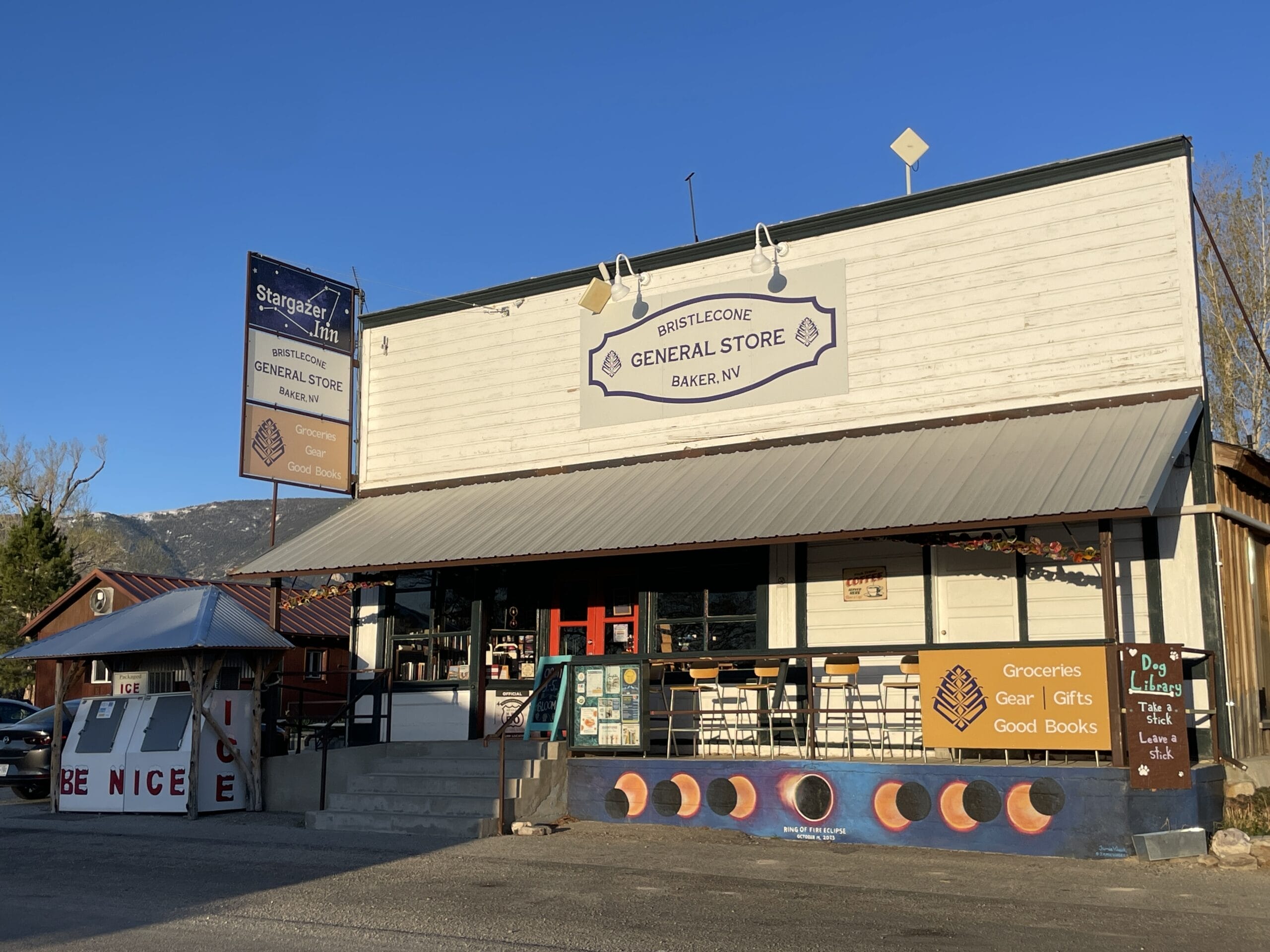
The Stargazer Inn and Bristlecone General Store are two of the local businesses in Baker, Nevada, that rely on and serve the tourists visiting the national park. Photo: Liz Woolzey
Liz Woolsey owns the Stargazer Inn with her husband, James, a former superintendent of Great Basin National Park. So far, bookings are holding steady. “We are getting a lot of reservations from two types of people,” she says. “There are those who say, ‘Yep, we’re coming because we want to support you and the national park,’ and there are those who want to get away from the news and their cell phones.”
In addition to the seven-room inn, the couple owns the neighboring Bristlecone General Store, which sells groceries, camping gear, books, and souvenirs. The store also hosts events. This summer’s schedule includes live music, comedy, meditation workshops, and full-moon hikes. Woolsey says the night sky was a particular draw in Baker. “Because we’re so high and dry, we have almost no light pollution,” she notes. “That’s what makes us such a great stargazing destination.”
In Ohio’s Cuyahoga Valley National Park, where TPL has protected more than 2,300 acres, several small towns dot the park. They were grandfathered in during the creation of the 33,000-acre site in the 1970s, during a push for more urban national parks. Cuyahoga is about halfway between Cleveland and Akron.
Stores and restaurants in towns like Peninsula, inside the park boundary, rely on the 3 million annual visitors to Cuyahoga Valley. Eddy’s Bike Shop does a brisk business in rentals, especially from April to October. The Ohio and Erie Canal Towpath Trail, a popular route for bicyclists, runs right through the park.
Cody Scott, a salesperson at Eddy’s, says bikers stop in to inflate their tires or purchase bike locks and lights. The shop also stocks snacks, protein bars, and beverages. Part of a small chain in the Cleveland area, Eddy’s opened in the national park a year and a half ago. “It was a market we couldn’t pass up,” Scott says. “People are everywhere on the weekends.”
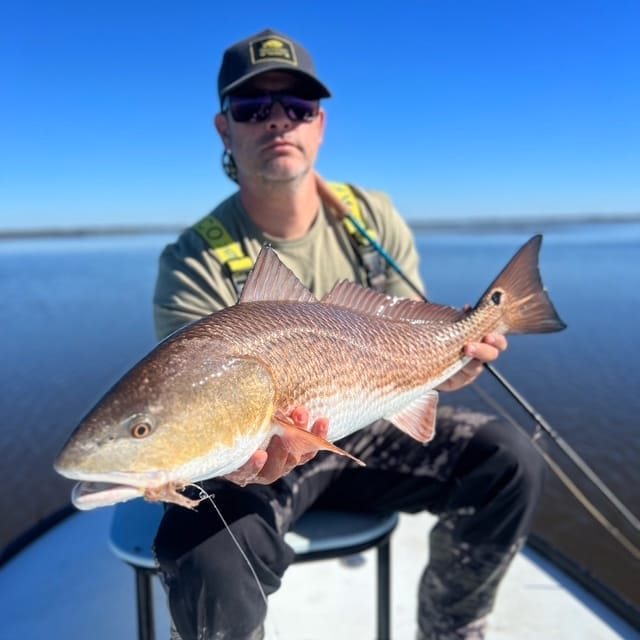
William Cochran, owner and proprietor of Amelia Island Outfitters, is just one of many small business owners who rely on access to the Timucuan Ecological and Historical Preserve. Photo: Amelia Island Outfitters
On the East Coast, the Timucuan National Ecological and Historic Preserve covers 46,000 acres of coastal wetlands along the Atlantic Ocean in Florida. That’s nearly twice the size of Disney World. Just east of Jacksonville, the preserve encompasses salt marshes, hardwood forests, historic sites, and nature trails. In recent years, Trust for Public Land has protected, among other properties within the preserve, a historic house that belonged to a former governor; a portion of a creek that provides boat access to the St. John’s River, and part of Fanning Island.
William Cochran is a fishing guide who owns Amelia Island Outfitters. He frequently takes clients into the Timucuan Preserve in search of redfish, speckled trout, and flounder. They venture into salt marshes and shallow bays in kayaks or aboard his 17-foot skiff, named Sadly but Shorely. A healthy, well-staffed Timucuan Preserve, he insists, is necessary for ecotourism in the region.
“The preserve is essential to my business,” Cochran says. “It means a lot to this area—just the availability of natural resources and the historic significance. It’s a place where you can feel like you’re in the middle of nowhere even though you’re right outside Jacksonville. It would be a major hit for a number of people if it wasn’t widely accessible.”
Lisa W. Foderaro is a senior writer and researcher for Trust for Public Land. Previously, she was a reporter for The New York Times, where she covered parks and the environment.
The Antiquities Act is one of America’s most effective conservation laws—it has created some of the most popular national parks, including scenic wonders like the Grand Canyon. But this critical conservation tool is under attack. Urge Congress to protect the Antiquities Act today!
