
The Hunt and the Harvest: Reaping Connection in Minnesota's Northwoods
For the uninitiated, the act and culture of hunting can feel unrelatable and best kept at a distance. But a unique, if unexpected, partnership is upending that paradigm by breaking barriers and challenging stereotypes.
By Deborah Williams | Photos by Andy Richter
Published October 1, 2025




Ronda, Mai, and Andre knew they were disrupting norms by walking into nature with firearms in search of grouse. What they didn’t expect was how dramatically it would redefine their relationships with the outdoors and public land—and reshape their personal convictions.
All three participated in the Mentored Hunting program dreamed up by TPL’s Nick Bancks and Keng Yang, a volunteer with Backcountry Hunters and Anglers (BHA) in Minneapolis, Minnesota. Designed to forge connections between new and experienced hunters who might not otherwise interact, the program starts with weeks of online education about hunting safety, ethics, and history, and it culminated with a weekend of firearms training and guided grouse hunting in Itasca State Park, about four hours north of the state capital.
These are their reflections—before, during, and after—in their own words.

KENG
I call myself an adult-onset hunter.
I’m the son of Hmong immigrants who were subsistence hunters in Laos. But since I was growing up in the U.S., I rejected my family hunting tradition. I used to view hunters as people who only take from the landscape.
It wasn’t until I got my hunting dog in my late 20s that I gave it a try and came to realize that hunters are some of the biggest contributors to conservation, and they have a deep appreciation for wildlife, for the environment, and for the importance of one to the other.
An individual hunter might take one deer or one pheasant or one squirrel off the land, but hunters as a whole are always thinking about how to keep those species thriving in partnership with the landscape.
Once that realization crystalized, I had to question what other misconceptions I held. One of the biggest: that hunters are mostly white men. Popular media perpetuates that image. My lived experience challenges it.
I wondered if the American hunting community is more diverse—or eager to be—than I thought.
I’m glad I found Nick and that TPL and BHA joined forces to answer that question by bringing more people along on this journey of discovery.
NICK
I’ve been struggling with how we can make the outdoors more equitable and diverse here in Minnesota. This program is the answer. Talk about mission alignment and impact.
I hope . . . no, I believe what we’re doing can be a blueprint. After all, what good is public land if people don’t feel safe, welcome, and empowered to enjoy it?
Our work to preserve these incredible places is made even more valuable because groups like BHA expose more people—more diverse people—to public land and teach them how to be stewards.
RONDA
What have I gotten myself into?
I accepted an invitation to take part in a grouse hunt in northern Minnesota. Me, a city person. Or at least a city amenities person. Sure, I go hiking every chance I get. I love camping and being outdoors. I even have fantasies about living in the country, but that would require a shift in how I live day-to-day. I’m not ready to go there.
I’ll have to use a gun, or at least carry one. Guns make me uncomfortable. They have the ability to take life in an instant. I’ve never imagined myself taking the life of an animal, let alone having to dress it. They call it dressing even though what you’re really doing is undressing it. You’re stripping its “clothes.”
The fact that we call animals “game” is also conflicting for me. If I’m playing a game, there’s an agreement with my opponent. We’ve agreed to the rules. These grouse haven’t agreed to anything. It’s not a game to them.
When I think of hunters, my mind only sees those grip-and-grin photos. Usually men, usually white, weapon in one hand, an animal in the other. They don’t appear to value nature or animals the same way I do.
I wouldn’t have done this of my own accord. But my job at TPL is to collaborate with staff and partners to provide as many equitable opportunities to connect with nature as possible. I focus primarily on people of color who have been strategically left out. And in the realm of hunting, I figured that was me. I’m a Black woman. I primarily live in cities. I don’t really know many hunters. They’ve certainly never invited me to join, except fishing a couple of times.
I’m also not one to back away from first-time opportunities. I relish trying new things. It gives my mind a lot of ease that I’ll be doing this with other women and people of color who’ve never hunted, and that I don’t have to show up in any certain way to prove myself. Deep breaths. Let’s see what I’m capable of.
Maybe this program will change my perceptions. Maybe it can it be a model for how TPL builds inclusivity in order to extend our impact on outdoor equity.
Hear More from Ronda on Episode 14 of TPL’s Podcast

ANDRE
I’ve been hunting for well over a decade, and I love it. But can I teach someone else to love it, especially someone like Ronda who isn’t even sure she’s ready to fire a gun?
We’ve never met in person, only over a video call a couple weeks ago. When Keng first asked if I’d do this, I assumed all the mentees were eager to hunt. It’s clear Ronda’s open to learning, but I don’t get the sense she’s intent on becoming a hunter.
I can relate because when I was younger, I loved animals, so I hated hunting. I saw the two as being in conflict. But I met some friends at church who were lifelong hunters, and they just said, “Let’s go out.” Little by little, I collected equipment and began to dabble more myself. I learned a lot by taking my stepson out. It’s hard to bond with kids, especially a stepchild. It’s even more awkward than regular parenting. We connected through hunting.
Now I share Keng’s desire to spread the goodness and conservation ethics of hunting, so I easily said “yes” when he asked me to do this. But now I’m nervous.
MAI
My grandmother would flip out if she knew I was doing this. She thinks it’s not safe and not a woman’s role. Historically, in Hmong culture, it’s men who do the hunting. The women stay behind. They clean and cook the animals, but they don’t hunt them. I always felt left out. I wanted to bring in the meat or at least try it.
During COVID, I became even more interested in and conscious about where my food comes from. That’s when I started exploring hunting, but it’s really male dominated. I wished there was a space for women and women of color to learn how to hunt and where I’d feel safe.
I found this program through an online BIPOC community. I didn’t know anybody, but I signed up nine months ago and tried to recruit family and friends. I dragged my boyfriend along for the first program—a turkey hunt—and he really enjoyed it too. We’ve gone on turkey- and duck-hunting trips, but I’ve yet to get a bird. I’m not gonna lie; I’d like to catch one. I don’t know if I can truly call myself a hunter until I do.


RONDA
Lots of orange. Lots of beards. That’s what I saw when I walked into the main cabin at the start of this weekend. We’d gathered to get to know each other over a spaghetti dinner. One man had a gun on his hip—at dinner! All I could think was these are not my people. Is that what they thought when they looked at me?
But then I remembered they’re not here to judge me; they’re here to embrace and welcome me into something they enjoy and hold dear. I owe it to them and to myself to remain open.

KENG
Validation. That’s what I felt this evening looking around the room at our second cohort of participants. We have men, women, and nonbinary mentees. We have white, Black, and Hmong mentors—some who’ve been hunting for decades and others who came to it in the past few years. A few have never even hunted this part of Minnesota or grouse. The only criteria for being a mentor is being comfortable hunting on public lands.
Most of the mentees seem excited. One or two are still nervous; I can tell. But I’m hopeful that we’ve paired them with mentors who will meet them where they are. Most importantly, we want everyone to feel empowered and that they belong here.
ANDRE
I feel a lot of pressure. I like to think I’m a good hunter and that my dogs are good at it. But we mainly hunt pheasant on open prairie. This part of Minnesota is new to us. Will I be able to give Ronda a meaningful experience? And, for that matter, what will make it meaningful? How do I define success? How does she?
MAI
When will I see myself as a hunter? When will others, even though I look different?
What I like about what Keng and Nick are doing is that they’re bringing people together who normally don’t interact with each other. This community is welcoming. Just hearing these mentors’ stories and their passion and drive for building this community . . . I’m glad I can be part of that. This program makes me feel safe and welcome as a woman and a person of color.
NICK
There are a lot of reasons this program is growing, but I think it boils down to one thing: representation. This isn’t just about bringing in diverse mentees. It’s about pairing them with mentors across the identity spectrum.
It’s no wonder some of the first-time mentees still look a little nervous; they’ve been led to believe hunters are a monolith driven only by a trophy mentality. Hunters don’t necessarily do themselves any favors on social media. We’re here to set that record straight by widening the aperture of what’s real.
For most of us in the room, it’s not about bagging the biggest animal or the most. It’s not even about the harvest. It’s about the experience of being in nature, and seeing the land through different eyes or from a different angle than they have before. If the mentees don’t quite see that yet, I’m confident they will tomorrow.


RONDA
I was anxious this morning. I didn’t know what to expect of Andre, or what he would expect of me. But his calm, patient temperament was great for my nervous system. I was happy to learn that his philosophy is less about harvesting an animal and more about having an experience and connection to nature. I was concerned about being paired with someone who would be aggressive or overly instructive, but he’s none of those things. He’s quiet. So today, I was quiet too. And I was open to experiencing nature the way he does.
I was energized by this morning’s brisk autumn air and the sharp aroma of wet pine. We could smell the dampness as we set out through the thick growth of the forest. I wasn’t prepared for the physicality of it. It’s nothing like hiking on a trail; we were bushwacking through dense forest and underbrush. It’s mental. You’re looking and listening for the animals to show you the way; you’re going toward them; you’re reading the landscape; you’re assessing the light and the wind for guidance; you’re trying to think like a bird.
What a different and deeply immersive way to connect with nature.
We didn’t see any grouse today. Am I disappointed? No. Did it diminish the experience? Not one bit. Am I open to trying again tomorrow? Absolutely.
ANDRE
We came up empty today. Ronda says she’s not worried about seeing a bird, let alone getting one. But as a hunter and a mentor, I feel like it’s my job to at least present the opportunity. For me, as a hunter who has brought others along, I really think it’s a bonus if you can get a new person to see it and to harvest something. I wanted that for Ronda.
KENG
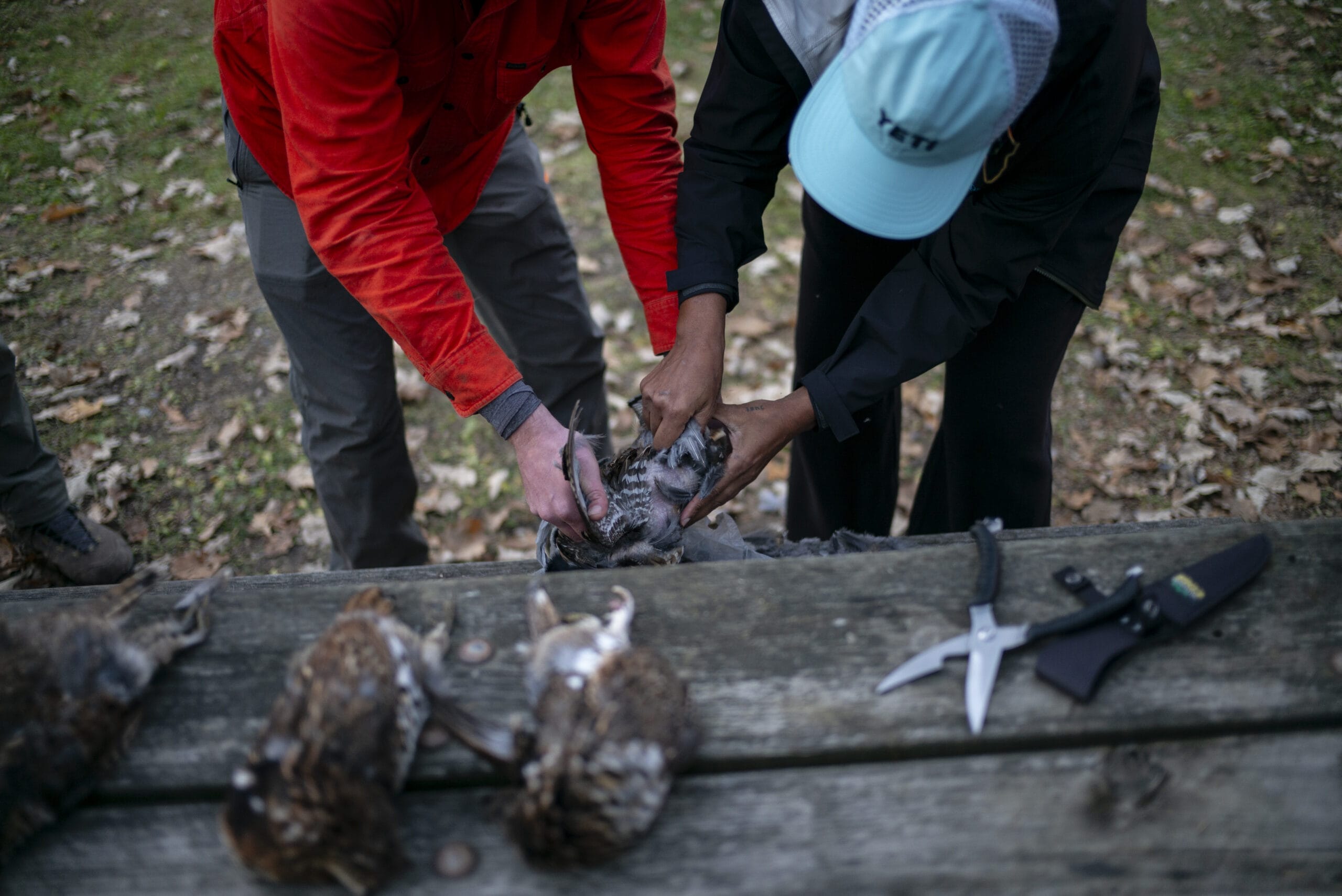
A few groups harvested birds today—grouse and woodcocks. Even the groups that came back empty-handed were thrilled for their cohorts and got to experience dressing, preparing, and eating the food for dinner. Sometimes people are hesitant with this, but I push them a little. Giving them an opportunity to hold and see the bird hopefully gives them a deeper respect for the animal and for hunting in and of itself.
ANDRE
There are a lot of movements around wholesome eating or eating organically, locally sourced. It’s like, guys, instead of going to the store and looking for these labels or shipping in organic food, you can have organic, locally sourced food if you hunt near home on public lands. I work in waste reduction and prevention. A lot of waste is because we’re not connected to our food. Hunters put a lot of effort into obtaining our food. If we understand that effort, we’re going to learn not to waste.

RONDA
My first thought when I woke this morning was fleeting: “Will we see any grouse today?” My second thought accompanied me all day: “If a bird presents itself, am I ready and willing to shoot?” Late this afternoon, I got the answer.
ANDRE
Today, I didn’t take a gun, and I let Ronda take the lead. Late in the afternoon, we had two flushes. The first grouse flew away. But the second one landed in a tree several yards away. Ronda saw it. She raised her gun. She quietly asked me if she should take the shot, and in that moment, I felt like a good mentor. “Up to you,” I said.
RONDA
I mounted the gun. I had the grouse in sight. I remember thinking, “What a great way to conclude the weekend.” I felt incredibly ready. So I pulled the trigger.
Click.
It didn’t fire. I looked down at the gun and instantly realized it was my mistake. I either didn’t push the pin the right direction, or I didn’t pack the shell correctly. The bird flew away. My heart sank.


MAI
Aside from learning how to hunt, the most important thing I’ve learned is that these public lands are out there waiting for us. The whole idea of public lands . . . I never really thought of them as being for hunting.
I still haven’t harvested anything, but something happened today that made me realize I am a hunter. We were driving and noticed a slight opening in the woods. Directly across the road from it was another opening. We could tell that was a deer trail, and we knew it was the path the deer regularly take to get to a food or water source. We’ve become aware of roosting environments. Now we see those things everywhere.
I still consider myself an environmentalist, but I didn’t let my bias get in the way of trying something new. And now my friends are expressing interest in hunting. I know what Keng and Nick are doing: They’re trying to turn us into mentors. I’m a newbie, but . . . even just participating in some of these hunts, now I consider myself a hunter.

RONDA
I thought the sting of my missed shot would last longer, but I released my disappointment after a few minutes. The question I had going into this wasn’t whether I would harvest a grouse. The question was whether I’d be willing to take the shot. Would I open myself up enough to the experience, to the discomfort, to this different way of connecting with nature?
Now I have the answer.
ANDRE
Ronda and I were only together for a day and a half, but I saw her evolve in that time from being content just to walk in the woods to having a true, deep desire to harvest the grouse.
Even though there was some regret that the bird flew away, there was also a sense that it didn’t matter because the moment itself was enough. The moment when she was able to make the transition from uncertain to certain that she was ready.
We need more people like Ronda who seek more insight about something before they judge it. Whether it’s hunting or religion or politics or ethnic groups. I think we could solve the world’s problems if we all did that.
This story was compiled and edited by TPL Editorial Director Deborah Williams. To hear more about this experience, check out episode 14 of our podcast, People. Nature. Big Ideas.

Donate to become a member, and you’ll receive a subscription to Land&People magazine, our biannual publication featuring exclusive, inspiring stories about our work connecting everyone to the outdoors.
