

You’re Seriously Underestimating Your Local Park
Swings and slides? Great. Sidewalk strolls? Lovely. But that patch of green has more up its sleeve. Think outside the picnic basket. Spice up your evening or weekend with one of these 10 not-to-be missed activities.
By Lisa W. Foderaro
Published October 6, 2025



1. Plan an Overnight Stay

Everyone pitches in to set up camp on this TPL field trip outside of L.A. Photo: Jorge Rivas
If you think your favorite park is a peaceful respite by day, imagine the serenity you’ll find spending a night there. Think: drifting off to the sound of a whippoorwill amid the scent of pine trees. Camping in your local community park is likely prohibited, but your nearest state park with a campground could be just the place for a close-to-home sleepaway and lickety-split reset. Or explore local camping blogs for recommendations. A pop-up tent, or instant tent, is a snap to erect, given the pre-attached flexible poles. And a sleeping pad—either foam or inflatable—and a warm sleeping bag will ensure a cozy night’s sleep.
2. Aesthete en Plein Air

Alexander Calder’s Eagle sculpture at Olympic Sculpture Park in Seattle, just north of downtown. This site was once an oil-tank farm and brownfield site. Photo: Seattle Art Museum
Crave art and culture but cringe in the stuffy confines of a museum or theater? Parks offer a verdant backdrop for music and dance. Seattle gets it. That’s why the city’s art museum and TPL partnered in 2007 to transform a contaminated outdoor space into the award-winning Olympic Sculpture Park. And there’s more on offer than statuary art: A free dance performance on October 19, called Sea Change Within Us, will explore issues relating to water and climate change. Members of Karin Stevens Dance will move amid large panels that touch on everything from sea level rise to Indigenous fishing rights. Tickets to two 60-minute performances, scheduled for noon and 4 p.m., can be reserved online.
3. Strike a Warrior Pose

A woman practices her warrior yoga pose outdoors. Photo: iStock
Nature inspires a sense of mindfulness, with its pleasing sounds, scents and visuals—or what Kathleen L. Wolf, a social scientist at the University of Washington’s College of the Environment, calls “soft fascinations.” What better place, then, to run through a sequence of asanas? Many yoga instructors host classes in parks. And park systems with robust programming often host free fitness classes, including yoga, in larger parks. So check your park department’s website for availability. Downward dog, anyone?
4. To Market, to Market

Saturday mornings at the Santa Fe Farmers’ Market are crowded with shoppers, sellers, and street performers. Tent after tent is filled with farm-fresh crops and handcrafted foods. Photo: iStock
Most grocery stores we know are warehouses spewing recirculated air from the vents and sonic gruel from the sound system. And you probably go every single week. You deserve better. Visit a farmers’ market in your local park to curate farm-to-table snacks and meals amid the sunshine and fresh air. At the Santa Fe Railyard Park and Plaza, the market features produce, meats, cheeses, baked goods, herbs, and chilis. How about a fresh roll topped with pepper jack cheese, arugula greens, and chili oil? Yum. Can’t wait till you get home? Cop a squat for an on-the-spot picnic. You’re at the park, after all. TPL acquired the railyard for the city and developed the park, which debuted in 2008. The Santa Fe Farmers’ Market is in the park every Saturday from 8 a.m. to 1 p.m. year-round.
5. Get Hitched

A rustic sign points the way to outdoor nuptials. Photo: iStock
Looking for a naturally beautiful backdrop for a wedding ceremony that won’t break the bank? Many parks allow couples to tie the knot for a relatively nominal fee. One beguiling venue in Atlanta is Historic Fourth Ward Park, a green space with terraced lawns, a 2-acre lake, and a dramatic waterfall. Trust for Public Land helped the city buy the property for the park, and the manmade lake doubles as a detention basin to prevent flooding. There are a number of spaces in the park suitable for a marriage ceremony, without the need for a permit. But to rent the park’s amphitheater, contact the Historic Fourth Ward Park Conservancy.
6. Spy a Bird
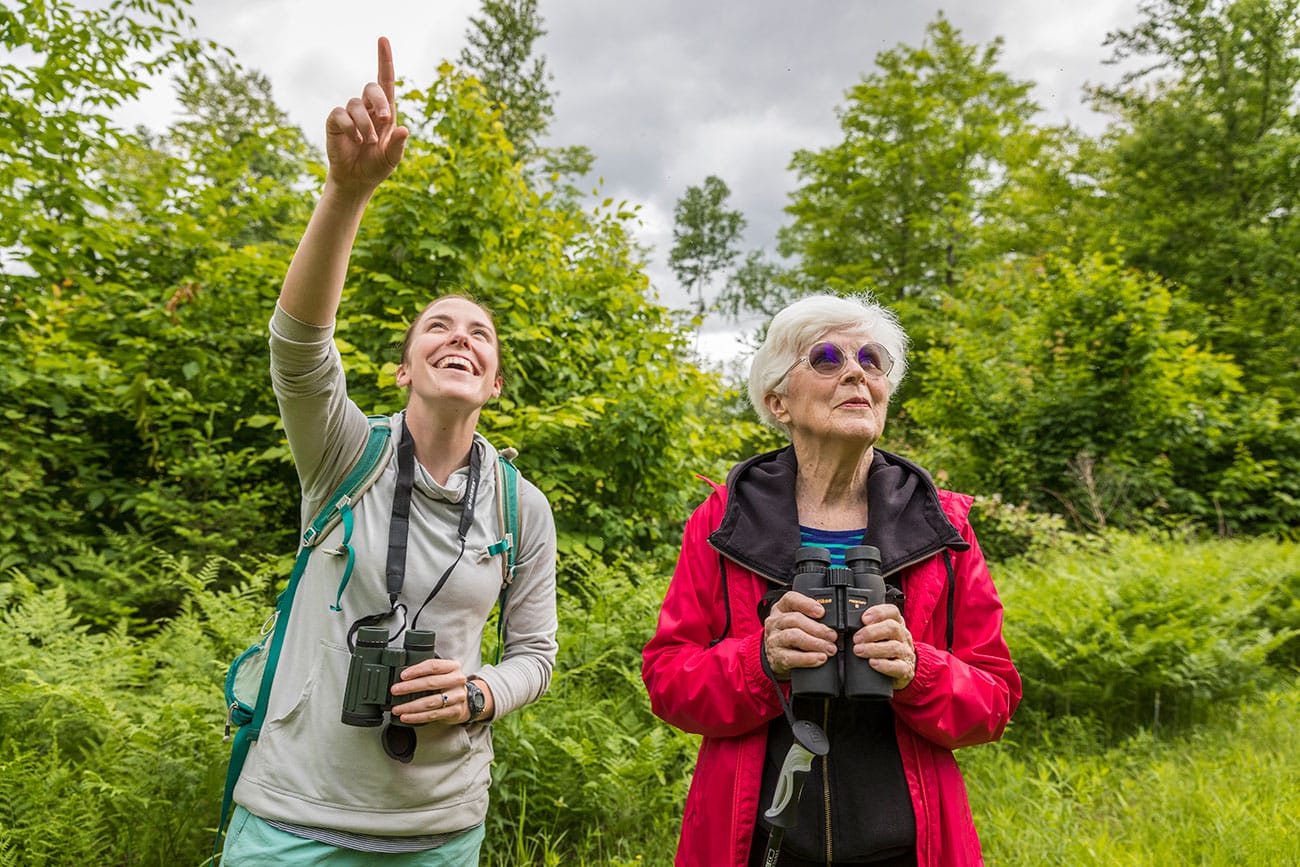
Two women birding at Bethel Community Forest in Maine. Photo: Jerry and Marcy Monkman
Bird-watching—or “birding,” to the those in the know—has taken the country by storm. Three out of ten adults, or 96 million Americans, engaged in birding in 2022. If you’re interested in spotting something a bit more challenging than a crow or pigeon, head to your local park. You don’t need special gear, but binoculars are a helpful tool. When you see an unfamiliar bird, take a picture or record its song. You can then identify it using a field guide or an app like Merlin Bird ID. The free app lets you upload photographs and audio recordings. Need some tips to get you started? Check this out.
7. Spice Up Your Stroll

A woman enjoys autumn weather and the view of fall foliage with her dog. Photo: iStock
Cool temperatures turn the color wheel of parks from shades of green to swirls of ocher, scarlet, and gold. While some leaf peepers hop in a car, viewing foliage on foot allows for closer observation. The Bloomingdale Trail in Chicago, an elevated park (also known as The 606) that TPL helped create, is flanked by trees. The Friends of the Bloomingdale Trail recently created “Trees of the Trail,” a self-guided tour you can download. The guide features 47 species, with descriptions of autumn hues. The “dark-green leaves” of the frontier elm, for instance, “turn a deep burgundy and purple color in fall.”
8. Rise to the (Fitness) Challenge

Joggers in New York’s Central Park get a dose of fresh air with their workout. Photo: iStock
Across the country, parks and trails host numerous marathons and shorter races. This fall and winter in New York City, three iconic green spaces—Central Park, Prospect Park, and Governors Island—are the settings for 5K and 10K races, as well as half marathons. A race organizer, NYCRUNS, sponsors events in those parks with whimsical names like the “Squirrel Stampede 10K” and, in winter, the “Frozen Pigeon 5K.” You can register for races on its website. Wouldn’t you rather be called a stampeding squirrel than a gym rat, anyway?
9. Luge at Your Leisure

A family sleds down a hill in their toboggan, making the most of a snow day. Photo: iStock.
Milano Cortina is a smidge far for most of us, but if the snow falls, you can host your own winter Olympics closer to home this February. When snow starts to fall, children and their guardians start plucking sleds and saucers from the back of the garage. But where to go? Ideally, a park with varied slopes (gentle for toddlers, challenging for teens). One such spot is Story Mill Community Park in Bozeman, Montana, which opened in 2019 with TPL’s help. From spring to fall, families take to the park’s 4-mile trail network, adventure playground, and climbing boulder. Come winter, however, they head to a dedicated sledding hill with toboggan-friendly terrain. An added bonus: majestic views of the surrounding mountains.
10. Do Some Journaling

A mother and her teenage son enjoy birdwatching and journaling in Beltzville State Park, Pennsylvania. Photo: iStock
Fall is a perfect time to open a journal and let nature be your muse. Journaling can take many forms: doodles, free association word play, poetry, song lyrics, or a realistic record of your experience. If you’re feeling artsy, choose a colored pencil, and sketch what’s right in front of you. Notice the different textures of the grass, shrubs, and trees. If writing’s your jam, jot down your impressions of the scene. How does the landscape look at this time of year? Is there any wildlife about? What associations do you have with the park?
Lisa W. Foderaro is a senior writer and researcher for Trust for Public Land. Previously, she was a reporter for The New York Times, where she covered parks and the environment.


Donate to become a member, and you’ll receive a subscription to Land&People magazine, our biannual publication featuring exclusive, inspiring stories about our work connecting everyone to the outdoors.
